The Stages of Healing: Navigating the Beautiful, Messy Journey of Growth

We often talk about healing as if it’s a finish line we cross—a magical moment where the pain disappears, the sky clears, and we are suddenly “fixed.”

But anyone who has ever walked through a season of deep change knows the truth: healing is a journey, not a destination.

It isn’t a straight line. It is an ebb and flow, a continuous cycle of unlearning, shedding, and rebuilding. If you are currently in the thick of your own evolution, wondering why it feels so challenging, it helps to understand the terrain.

Paths and roads winding through multiple landscapes including forests, fields, mountains, desert, coastline, grasslands, and volcanic terrain.
A collage of various natural paths winding through different landscapes from forests to deserts and volcanic areas.

Here are the nine stages we move through as we heal, grow, and reclaim our power.

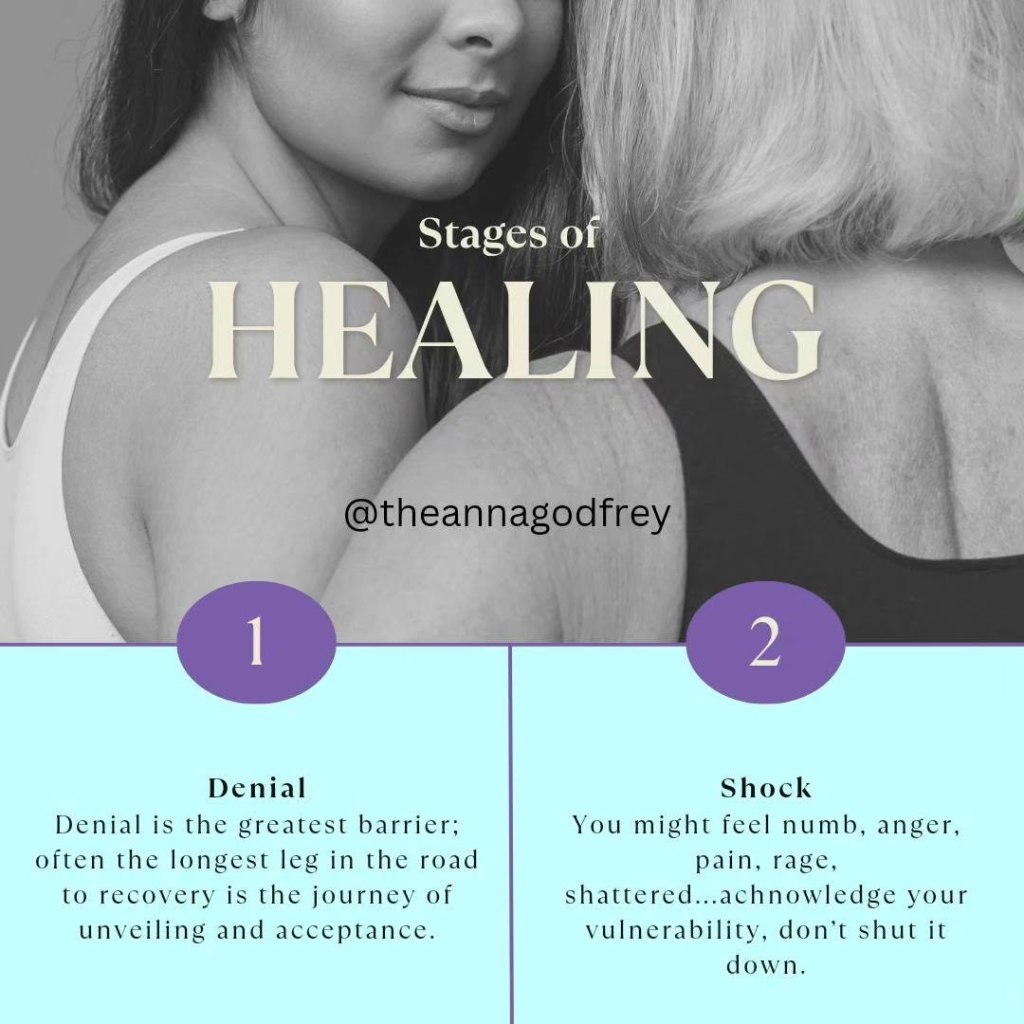
1. Denial

Denial is a protective blanket our mind throws over us when the truth feels too heavy to bear. It is often the greatest barrier to our evolution. The longest, most exhausting leg of the road to recovery is simply the journey of unveiling the truth and moving toward acceptance. Healing cannot begin until we stop hiding from what is.

2. Shock

When the denial fades, reality hits. In this stage, you might feel entirely numb, or you might be flooded with intense anger, pain, rage, and a feeling of being completely shattered. The key here is survival through allowance: acknowledge your vulnerability; do not shut it down. Let the storm pass through you without judging it.

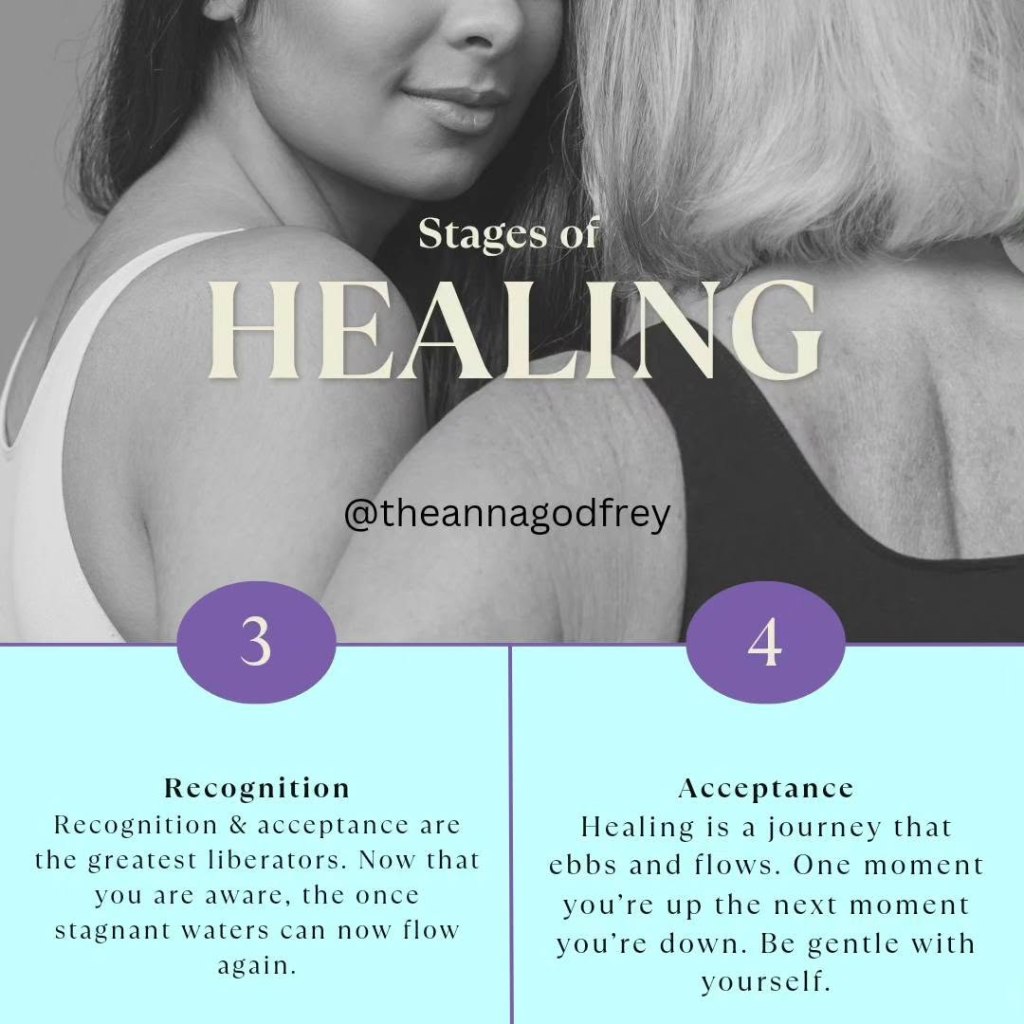
3. Recognition

This is the turning point. Recognition combined with acceptance are the greatest liberators of the human spirit. The moment you look your reality in the eye and say, “This is what happened, and this is where I am,” the once stagnant waters of your life can finally begin to flow again.

4. Acceptance

Acceptance doesn’t mean you love what happened; it means you stop fighting it. This stage is a fluid journey that ebbs and flows. One moment you are standing strong on the mountaintop, and the next moment you feel down in the valley again. This is normal. Be gentle with yourself during the dips.

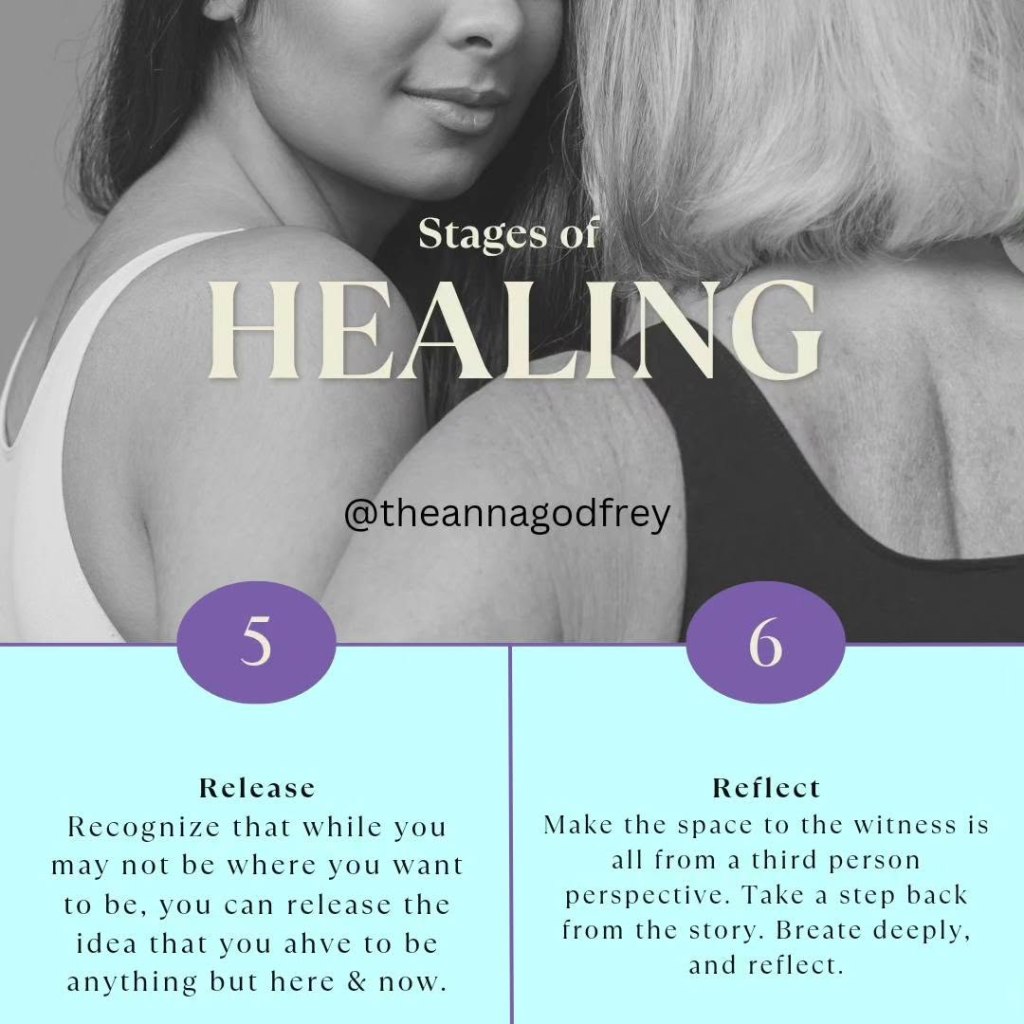
5. Release

True peace comes when we stop fighting the present moment. In the release phase, you recognize that while you may not be exactly where you want to be yet, you can release the heavy expectation that you have to be anything but here and now. You are allowed to just exist as you are today.

6. Reflect

To heal deeply, we have to step out of the chaos of our own minds. Make the conscious space to witness it all from a third-person perspective. Take a step back from the narrative, pull yourself out of the drama of the story, breathe deeply, and simply reflect on how far you’ve come.

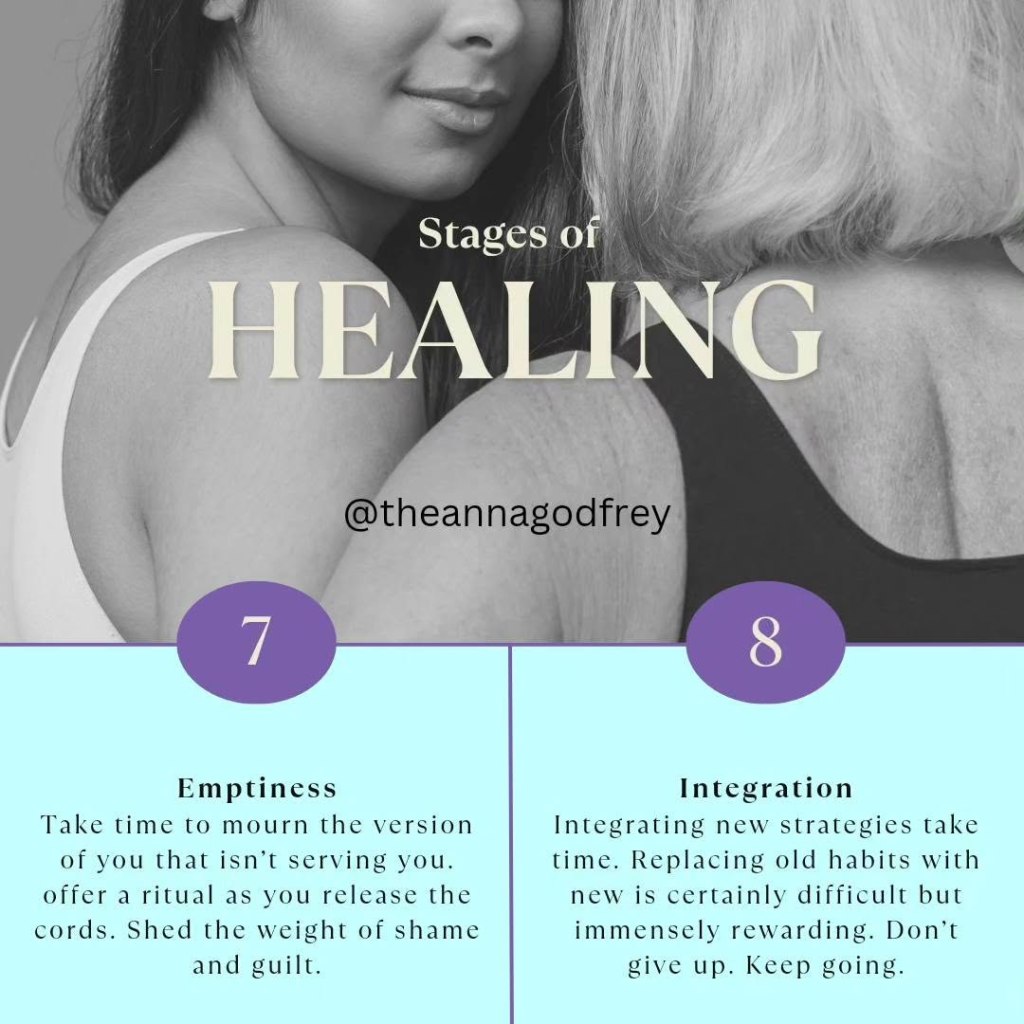
7. Emptiness

Before you can fill your cup with new, vibrant energy, you have to sit with the space left behind. Take the time to mourn the older version of you that is no longer serving your highest good. Offer yourself a quiet ritual as you cut those energetic cords. Shed the heavy weight of shame and guilt; they have no place in your future.

8. Integration

This is where the real work happens. Integrating new, healthy strategies takes time and conscious effort. Replacing lifelong, survival-driven habits with new, mindful practices is undeniably difficult, but it is immensely rewarding. When it feels tough, don’t give up. Keep going.

9. Transform

The final shift. This is where you begin actively making changes where you feel they are most appropriate for your unique journey. Remember: there is absolutely no rush. One single step at a time is enough, because small, consistent changes move mountains.

A Gentle Reminder for Today: Healing takes time. There is no timeline, no schedule, and no competition. Trust the process, honor exactly where your feet are planted today, and above all, be kind to yourself.

How are you nurturing your nervous system through your own healing journey today? Which stage resonates with you the most right now? Let’s connect in the comments.

#HealingJourney #SelfCare #MentalHealth #PersonalGrowth #EmotionalHealing #Mindfulness

Ride the Wave: Finding Freedom from the Grip of Intense Urges

Have you ever felt completely overwhelmed by a craving? That intense pull towards something you know, deep down, you might regret later? Whether it’s the urge to reach for that extra snack, scroll endlessly on social media, or engage in any other habit you’re trying to break, these urges can feel like powerful forces dictating your actions.

For so long, the common advice has been to fight these urges – to grit your teeth, use sheer willpower, and push through. But what if there was a different way? A way that acknowledges the intensity of these feelings without getting swept away by them?

Enter the concept of “Urge Surfing.”

Imagine an ocean wave. It starts small, gradually builds in intensity until it reaches a powerful peak, and then eventually, it begins to subside, gently rolling back to calm waters. Our urges often behave in a similar way. They have a beginning, a middle, and an end.

Understanding the Anatomy of an Urge Wave:

As the image beautifully illustrates, urge surfing involves recognizing and riding these waves of desire:

  • The Trigger: Something sparks the urge. It could be a thought, a feeling, a place, a person, or even a sensory experience like a smell or a taste. You suddenly feel that familiar pull.
  • The Urge Rise: This is when the urge starts to intensify. You might notice physical sensations like a racing heart, sweating, or fast breathing, as your mind becomes more and more focused on the desired behavior.
  • The Peak: This is the most intense point of the urge. It can feel all-consuming, like it will never go away. You might experience strong emotional and physical discomfort.
  • The Fall: Just like a wave, the urge will eventually start to lose its power. The intensity begins to fade, and you start to feel a sense of relief, both mentally and physically.

The Counterintuitive Power of Riding the Wave:

Our natural instinct when faced with an intense urge is to fight it, to push it away with all our might. But often, this resistance can actually amplify the urge, creating an internal struggle that leaves us feeling drained and more likely to give in eventually.

Urge surfing offers a different approach: acceptance and observation. Instead of fighting the urge, you acknowledge its presence and observe it without judgment, much like a surfer observes and rides a wave.

Why Does This Work?

  • It Acknowledges Reality: Urges are a normal part of the human experience. Trying to suppress them entirely can be exhausting and often backfires.
  • It Highlights Temporality: By observing the urge, you begin to notice its natural ebb and flow. You realize that even the most intense urges are temporary and will eventually pass.
  • It Reduces the Power Struggle: When you stop fighting, you reduce the internal conflict, which can lessen the intensity and distress associated with the urge.
  • It Builds Self-Awareness: You become more attuned to your triggers, the physical sensations of the urge, and how it changes over time.

How to Practice Urge Surfing:

  1. Identify the Trigger: What situations, thoughts, or feelings tend to bring on the urge?
  2. Notice the Urge Rise: Pay attention to the physical and emotional sensations as the urge intensifies. Where do you feel it in your body? What thoughts are going through your mind?
  3. Ride the Peak: Instead of acting on the urge, simply observe it. Notice its intensity without judgment. Remind yourself that this feeling is temporary. Breathe deeply.
  4. Observe the Fall: As the urge begins to subside, notice the shift in your sensations and thoughts. Acknowledge your ability to ride it out.

More Than Just Waves:

Think of it like riding out a strong emotion, like sadness or anger. If you try to suppress it completely, it might fester. But if you allow yourself to feel it, observe it, and let it run its course, it will eventually dissipate.

Urge surfing is a skill that takes practice, but it offers a powerful alternative to the exhausting battle of constant willpower. It’s about learning to relate to our urges with curiosity and acceptance, knowing that even the biggest waves eventually return to calm waters.

Are you ready to try riding the wave?

Level Up Your Mood: Your Awesome Adventure to a Happier You!

Hey awesome people!

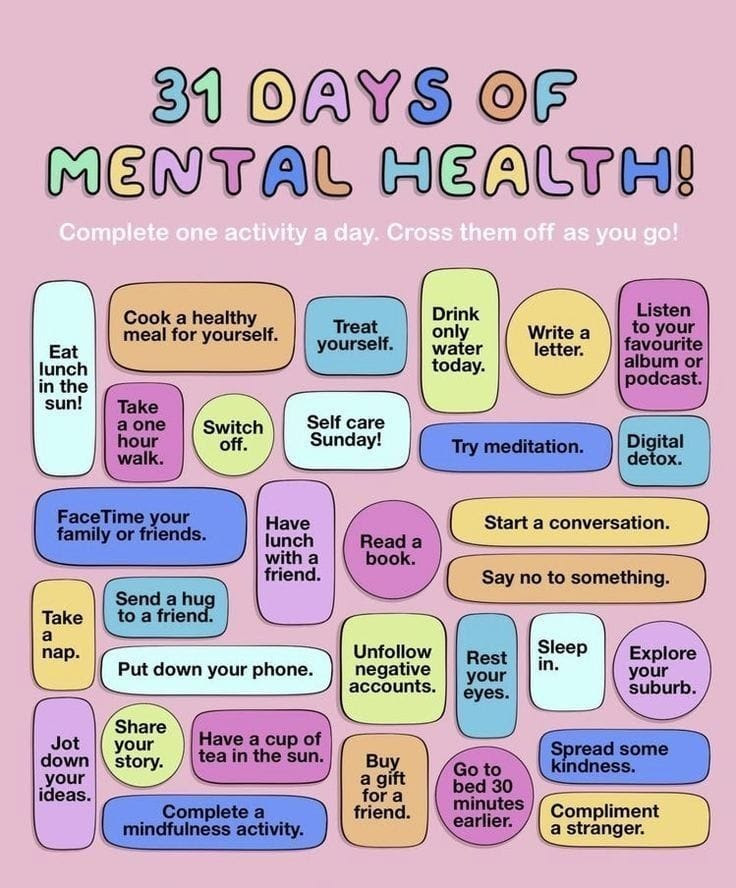
Ever feel like your mental health could use a little boost, a little sprinkle of sunshine? Well, guess what? I stumbled upon this super cool idea – a whole month packed with little missions to make your mind feel fantastic!


Seriously, check this out. It’s like a fun advent calendar, but instead of chocolate (though hey, treat yourself is on there!), it’s filled with simple, doable things you can do each day to nurture your well-being.


What I love about this is that it breaks down taking care of yourself into bite-sized, non-scary chunks. We’re not talking about climbing Mount Everest of self-care here. We’re talking about things like eating lunch in the sun (hello, Vitamin D and good vibes!), cooking a healthy meal (you’re a rockstar chef!), or just putting down your phone for a bit (gasp! The world won’t end, I promise!).


And the variety? It’s like a mental health buffet! One day, you might be channeling your inner wordsmith by writing a letter. The next, you’re a zen master trying out meditation. You could be a social butterfly FaceTiming friends or family, or a cozy caterpillar curled up with a good book. There’s even a “Self-care Sunday” – because Sundays were practically invented for pampering!


What I’m taking away from this is that looking after your mental health doesn’t have to be a grand, complicated affair. It’s about weaving these little moments of kindness to yourself into your daily routine. It’s about those small wins that add up to a bigger, brighter picture.


So, are you ready to join the adventure? You don’t have to wait for a specific month to start. Pick an activity today, cross it off (imagine the satisfying feeling!), and feel that little lift. Let’s make every day a step towards a happier, healthier, and more awesome you!


What activity are you most excited to try? Let me know in the comments – let’s cheer each other on! ✨

Mental Health and the real-life struggle.

This needs to be shared, needs to be read, and most importantly, this needs to be heard.

Sertraline – Zoloft
Venlafaxine – Effexor
Citalopram – Celexa
Mirtazapine – Remeron
Fluoxetine – Prozac
Duloxetine – Cymbalta
Quetiapine – Seroquel
Lamotrigine – Lamictal
Escitalopram – Lexapro
Bupropion – Wellbutrin
Lorazepam – Ativan
Clonazepam – Klonopin
Aripiprazole – Abilify
Carbamazepine – Tegretol
Buspirone – Buspar

You may know what these tablets are or know a loved one who takes them, but in case you don’t, I will fill you in. These medications allow some people to deal with normal day to day life. Although most days they can also leave them tired, spaced out, emotionless or even super emotional.

Crazy right? Why would anyone want to feel like that?

Well, this is why!

You see, some people suffer from severe depression, anxiety, and PTSD. In their brain. things don’t sit quite right. Something seems different. They notice little differences that other people wouldn’t. Most days, they wake up sick and feel sleepless. They consistently overthink every situation. Was that comment about them; was it a joke? Was that person supposed to laugh, or did they mean it? Are they nice? Are they talking about them? Do they talk about them? They then think, I bet they don’t like me, really.
They say sorry all the time. They feel like they annoy everyone. Also, for all those questions, they will spend hours trying to answer. Let it all build up in their mind until it sends them to tears… it’s ‘mental’ that they see things that way.

It’s not only mental changes but physical changes. They don’t eat a lot or they eat way too much. Insomnia, up all night, answering questions to situations that don’t even exist or sleep too much and waste half their day still feeling tired. They still smile, and they have every excuse for when you ask why. But the tablets can help them. Because they know when they start to feel this way or think this way, they need help. They know that when their behavior starts to change, they need guidance, and they understand that they don’t need to be ashamed. They don’t need to be understood. They just need to be accepted. Everyone is fighting a battle, and sometimes, you just need to be kind.
So I may just be another person who’s talking about mental health. Living with this illness is hard, but trying to understand it is even harder. It’s also 100 times harder if you have another condition on top of this.

Do not suffer in silence.

Mental health is just as important as physical health.

Be part of the healing.💙

Be understanding.💙

BE KIND.💙

Know that people are here to listen, not to judge, and to hold your hand when things seem to be so tough that you can no longer go on!

#mentalhealthawareness

💙 Copied and pasted