Daily Journaling Prompts: Guided Reflections for Clarity, Focus, and Personal Growth

Unplugging for just five minutes a day to put pen to paper can transform how you navigate your inner world. Journaling isn’t about writing a masterpiece; it’s a grounded practice to clear mental clutter, anchor your focus, and track your personal evolution.

Woman writing in a journal beside a candle, plant, and window
A woman journals by candlelight in a warm, plant-filled reading nook as evening settles outside.

Use these prompts to build a daily practice that aligns your mindset and grounds your energy.

Morning Prompts: Setting Focus & Intentionality

Start your day by directing your mental energy toward what truly matters before the noise of daily to-dos takes over.

  • Intentionality: What is one emotion or mindset I want to embody today, and what is one small action that supports it?
  • Prioritization: If I could only accomplish one thing today that would make me feel deeply satisfied, what would it be?
  • Energy Audit: What am I currently holding onto that I need to release to step into today with clarity?

Midday Check-In: Centering & Resetting

Pause halfway through your day to reconnect with your body and mind.

  • Grounding: Take three deep breaths. What sensations am I experiencing in my physical body right now?
  • Course Correction: Has my focus shifted away from my morning intention? How can I gently guide myself back?
  • Micro-Gratitude: What is one simple highlight, interaction, or comfort from this morning that I can appreciate right now?

Evening Reflections: Integration & Growth

Wind down your day with quiet introspection, transforming everyday experiences into lasting self-awareness.

  • Self-Discovery: What challenged me today, and what did my response reveal about my current growth?
  • Celebration: What is a win from today—no matter how small—that deserves recognition?
  • Rest: What thought, worry, or task do I need to store on this page so my mind can rest deeply tonight?

Tips to Keep Your Practice Sustainable

  • Keep it Low-Pressure: You don’t need to answer every prompt. Pick the single line that resonates most with where you are right now.
  • Create a Ritual: Pair your writing with a quiet moment—a warm morning drink, a favorite candle, or five minutes of stillness before bed.
  • Focus on Honesty Over Formatting: Let your writing be raw and unedited. The value lies in the self-expression, not the grammar.

Which area of your routine—morning focus, midday resets, or evening reflection—are you most looking forward to expanding?

Reclaiming Your Vision: How to Dream Big When You’re Used to Putting Everyone Else First

When you spend years—or decades—focusing entirely on the needs of your family, team, and community, a funny thing happens when someone asks, “What do you want for yourself?”

Your mind goes blank.

It isn’t that you lack ambition or imagination; it’s that your “desire muscle” has atrophied from disuse. When every ounce of your energy goes into supporting others, wanting things for yourself can feel unnatural, overwhelming, or even selfish.

Dreaming big isn’t a personality trait—it’s a practice. If you find it hard to set goals for yourself, here is how to give yourself permission to dream, along with exercises to help expand your vision.

Open doorway overlooking a Tuscan countryside landscape at sunset
An open rustic doorway frames a glowing Tuscan landscape at sunset.

Step 1: Give Yourself Permission to Want

Before you write down a single goal, you have to address the quiet guilt that often comes with focusing on yourself.

Taking care of your own future doesn’t mean neglecting the people you love. In fact, when you build a clear, fulfilling vision for your life, you show up stronger, more energized, and more grounded for everyone around you. Personal goals aren’t a subtraction from your family; they are an addition to the ecosystem of your life.

Step 2: Exercises to Expand Your Vision

If jumping straight to “Where do you see yourself in five years?” feels paralyzing, use these reflective exercises to ease into dreaming big.

Exercise 1: The “No-Limits” Inventory We often limit our goals before they even hit the page because we instantly calculate the time, money, or effort required.

  • The Prompt: Write down 10 things you would pursue, try, or build if you had guaranteed success, unlimited financial resources, and complete support from everyone in your life.
  • The Goal: Take practical obstacles off the table temporarily so your true interests can surface.

Exercise 2: The Ideal Average Day Dreaming big doesn’t always mean launching a global company or moving to a tropical island. Often, the most powerful dreams start with how you want to feel day-to-day.

  • The Prompt: Describe a typical Tuesday five years from now in vivid detail.
    • What time do you wake up?
    • What does your morning routine look like before anyone else enters the room?
    • What kind of work or creative projects are you engaging in?
    • How does your energy feel when you go to bed?
  • The Goal: Shift your perspective from what you should accomplish to how you want to live.

Exercise 3: The Energy Audit If you aren’t sure what you want, start by paying attention to what gives you life right now.

  • The Prompt: Over the next three days, keep a simple list with two columns: Energy Givers and Energy Drainers. Notice the small moments—a specific conversation, learning something new, a quiet walk, or a creative project—that leave you feeling lit up.
  • The Goal: Your future goals lie in the direction of your energy givers.

Step 3: Turn Broad Dreams into Small Steps

Once a spark of a dream emerges, don’t worry about mapping out the entire mountain. You only need to see the next step.

  1. Pick One Anchor Goal: Choose just one small thing that is 100% for you—not for your household, job, or family.
  2. Make it Frictionless: Break it down into an action so small it feels almost too easy. (e.g., instead of “write a book,” start with “write for 10 minutes every Tuesday”).
  3. Protect Your Time: Block out non-negotiable time on your calendar for this goal, exactly as you would for a family member’s appointment.

Give It Time

Expanding your vision is a gradual process. If your dreams feel modest at first, celebrate them. The ability to want things for yourself grows with practice, and every small step you take toward your own goals sends a powerful message to yourself: Your future matters, too.

Layered paper artwork featuring a compass, winding paths, stars, moons, and creative symbols
Layered paper pathways weave together navigation, creativity, travel, and discovery in a richly detailed blue artwork.

Printable Journaling Prompts: Rediscovering YOU (PDF Version)

Print or screenshot these prompts, grab your favorite pen, and spend 10–15 minutes sitting with them in a quiet space. Remember, there are no right or wrong answers—only honest ones.

Uncovering Your Desires

  • What is one activity, hobby, or project I used to love before life got busy that I miss doing?
  • If I had two hours of completely uninterrupted, guilt-free time every week, how would I choose to spend it?
  • What is a secret goal or project I’ve been afraid to name out loud because it feels “too big” or impractical?

Shifting Perspectives

  • In what areas of my life am I giving away all my energy, and what is one small boundary I can set to reclaim some for myself?
  • If a dear friend came to me with the exact same dream I have, what encouragement would I give them? Why don’t I say those words to myself?
  • What does success look like to me—not to my family, my job, or society?

Visualizing Your Future Self

  • Fast-forward one year: What is one decision I could make today that my future self would deeply thank me for?
  • Describe three emotions I want to feel more consistently in my daily life, and list one small habit that helps invite each emotion in.
  • Complete this sentence five different ways: “I give myself full permission to…”

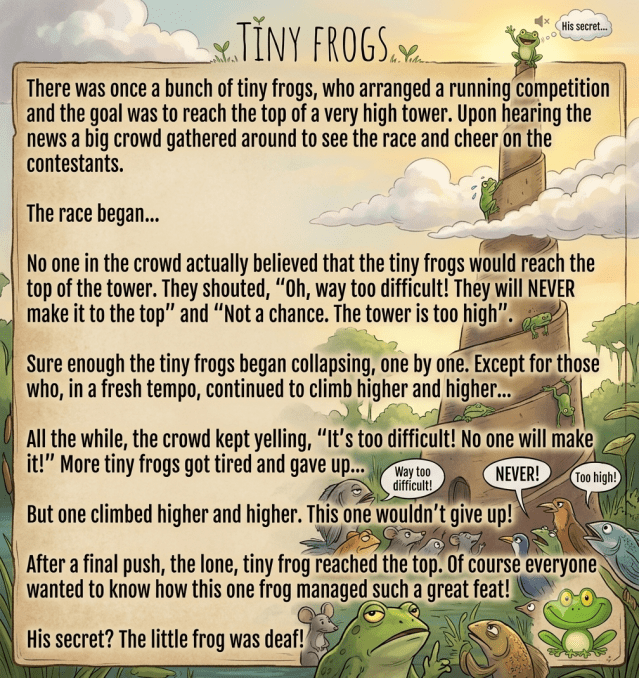
Embrace Selective Hearing for Success

🐸 Be deaf to the noise. 🐸

The story holds such a powerful lesson for anyone trying to build a healthier, more intentional life, or pursuing a big goal.

When you decide to make a shift—whether it’s starting a new fitness routine, prioritizing your mental health, or choosing consistency over old habits—the “crowd” will always have something to say. Sometimes that noise comes from well-meaning people, sometimes it’s societal pressure, and honestly, sometimes it’s just the loud, doubtful voice inside our own heads telling us the tower is too high to climb.

If you listen to every voice telling you why it won’t work, why it’s too hard, or why you should just blend back in, you’ll find yourself giving up before you ever see what you’re capable of.

Your growth requires a beautiful kind of selective hearing. Tune out the critics. Tune out the limitations others try to place on you. Protect your peace, anchor yourself in your purpose, and just keep climbing—one step, one round, one mindful breath at a time.

You don’t need the crowd’s permission to reach the top. ✨

Drop a 🧠 or a 🐸 in the comments if you’re choosing to tune out the noise and focus on your alignment this week!

#MindsetMatters #TuneOutTheNoise #Consistency #PersonalGrowth #Mindfulness #KeepClimbing #HealthyHabits

The Mid-Year Reset: How to Recalibrate Your Wellness Goals Without the Pressure

We’ve officially crossed the threshold into the midpoint of the year. Take a deep breath and let that sink in.

Winding mountain trail with sunrise above foggy valley and snow-capped peaks
A winding mountain path leads toward a sunrise above fog-filled valleys

Back in January, many of us set big, ambitious goals. We made promises about our fitness routines, our nutrition, and our daily habits. But life happens. Routines shift, schedules get chaotic, and sometimes the rigid goals we set in the dead of winter simply don’t align with the reality of our lives today.

Typically, a mid-year check-in can trigger a sense of guilt or pressure to “catch up.” But what if we abandoned the intense, rigid “New Year, New You” mentality entirely?

Instead of pushing harder, mid-year is the perfect time for a gentle, mindful recalibration. It’s an opportunity to assess how your body and mind actually feel right now, and to adjust your sails accordingly. Here is how to hit the reset button with grace, intuition, and kindness toward yourself.

Step 1: Check In with Your Nervous System First

Before you open your planner, look at your calendar, or write down a single new goal, you need to check in with your internal state. True wellness cannot be built on a foundation of chronic stress or exhaustion. If your nervous system is dysregulated—meaning you are living in a constant state of fight-or-flight, anxiety, or burnout—adding a demanding new fitness or wellness goal will only act as another stressor.

Before you redefine what success looks like for the next six months, ask your body a few questions:

  • How is my energy when I wake up?
  • Am I holding tension in my jaw, shoulders, or gut?
  • What does my mind need most right now—more stimulation, or more stillness?

By grounding yourself first, you ensure that your goals come from a place of deep self-care and cellular preservation, rather than a place of perceived inadequacy.

Step 2: Give Yourself Permission to Pivot

Consistency is the holy grail of health, but consistency doesn’t mean rigidity. There is a profound difference between quitting on yourself and making a conscious, mindful pivot.

Take a look at the routines you’ve been trying to force yourself into over the last few months. If your current gym routine leaves you feeling completely drained instead of energized, or if a strict nutrition plan is creating mental fatigue, it’s not a failure—it’s feedback.

Give yourself permission to pivot. If high-intensity workouts aren’t serving your body right now, swap them for consistent boxing classes that let you release stress, or focused strength training sessions coupled with restorative movement. If your daily schedule has transformed, shift your focus to “micro-dosing” your wellness—five minutes of breathwork here, a short walk there. Your wellness routines should support your life, not complicate it.

Step 3: Clear the Mental Clutter (A 5-Minute Exercise)

Sunlit indoor corner with potted plants, an open journal, a pen, a mug, and a green yoga mat on a wooden floor
A cozy sunlit corner with plants, a journal, and a yoga mat by a large window

To step into the second half of the year with clarity, we need to empty our mental cups. When we carry the weight of unmet expectations or outdated goals, we leave no room for new growth.

Try this quick, 5-minute mindfulness exercise today to clear the clutter and reset your focus:

  • Minute 1-2: Ground and Breathe. Sit comfortably with your feet flat on the floor and close your eyes. Place one hand on your heart and one on your belly. Take three deep, slow inhalations through the nose, expanding your belly, and let them out through the mouth with a sigh. Let your shoulders drop.
  • Minute 3: The Witness. Bring to mind the goals or expectations you’ve been carrying that feel heavy. Witness them without judgment. Acknowledge the effort you’ve made so far this year.
  • Minute 4: The Release. As you exhale, mentally release the pressure to be anywhere further along than you are right now. Silently say to yourself: “I release what is no longer serving my health, and I welcome what brings me balance today.”
  • Minute 5: Setting the Intention. Open your eyes. On a blank piece of paper, write down just one feeling you want to cultivate over the next six months (e.g., Peace, Strength, Vitality, Clarity). Let that single feeling dictate your daily habits moving forward.

Moving Forward with Intention

Abstract painting with swirling patterns of blue, brown, and white creating a vortex effect
A vibrant abstract painting of swirling blue and brown hues forming a dynamic vortex

Mountains are moved one small, consistent step at a time. As we navigate the rest of this year, remember that taking care of yourself is a continuous journey of listening, adapting, and trusting the process. Be kind to your body, protect your peace, and move at a pace that honors your health from the inside out.

How does your body feel as we cross into the second half of the year? What is one routine you are giving yourself permission to pivot on today? Let’s connect and support each other in the comments below.

#MidYearReset #Mindfulness #NervousSystemRegulation #HolisticHealth #SelfCare #GoalSetting #PersonalGrowth

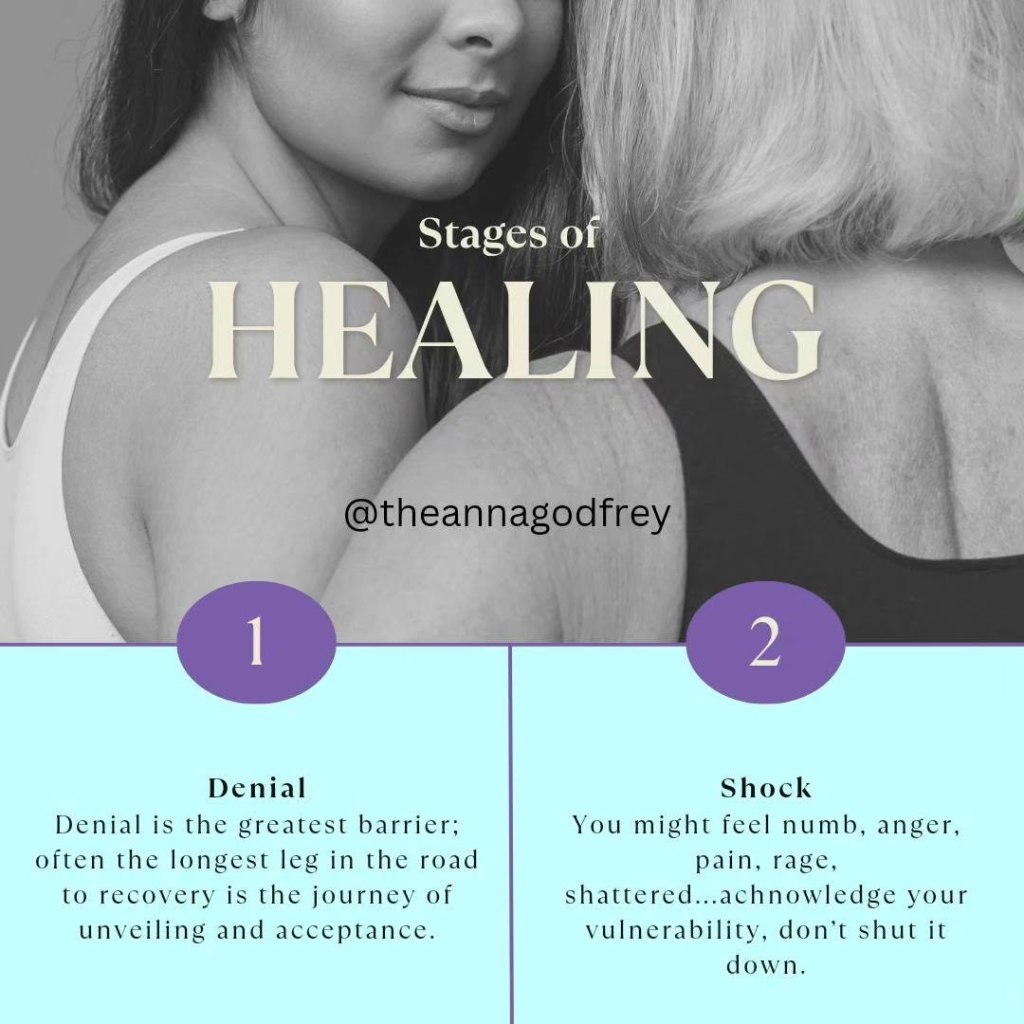
The Stages of Healing: Navigating the Beautiful, Messy Journey of Growth

We often talk about healing as if it’s a finish line we cross—a magical moment where the pain disappears, the sky clears, and we are suddenly “fixed.”

But anyone who has ever walked through a season of deep change knows the truth: healing is a journey, not a destination.

It isn’t a straight line. It is an ebb and flow, a continuous cycle of unlearning, shedding, and rebuilding. If you are currently in the thick of your own evolution, wondering why it feels so challenging, it helps to understand the terrain.

Paths and roads winding through multiple landscapes including forests, fields, mountains, desert, coastline, grasslands, and volcanic terrain.
A collage of various natural paths winding through different landscapes from forests to deserts and volcanic areas.

Here are the nine stages we move through as we heal, grow, and reclaim our power.

1. Denial

Denial is a protective blanket our mind throws over us when the truth feels too heavy to bear. It is often the greatest barrier to our evolution. The longest, most exhausting leg of the road to recovery is simply the journey of unveiling the truth and moving toward acceptance. Healing cannot begin until we stop hiding from what is.

2. Shock

When the denial fades, reality hits. In this stage, you might feel entirely numb, or you might be flooded with intense anger, pain, rage, and a feeling of being completely shattered. The key here is survival through allowance: acknowledge your vulnerability; do not shut it down. Let the storm pass through you without judging it.

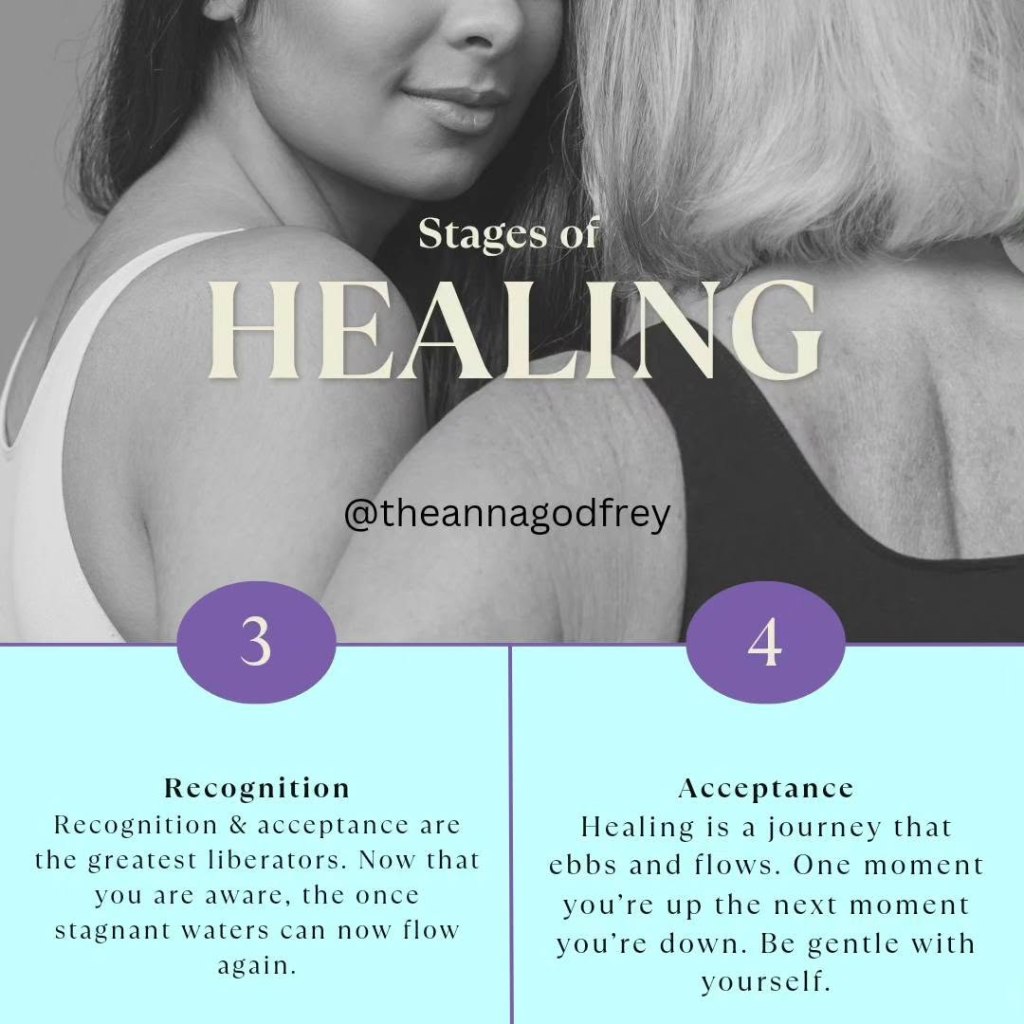
3. Recognition

This is the turning point. Recognition combined with acceptance are the greatest liberators of the human spirit. The moment you look your reality in the eye and say, “This is what happened, and this is where I am,” the once stagnant waters of your life can finally begin to flow again.

4. Acceptance

Acceptance doesn’t mean you love what happened; it means you stop fighting it. This stage is a fluid journey that ebbs and flows. One moment you are standing strong on the mountaintop, and the next moment you feel down in the valley again. This is normal. Be gentle with yourself during the dips.

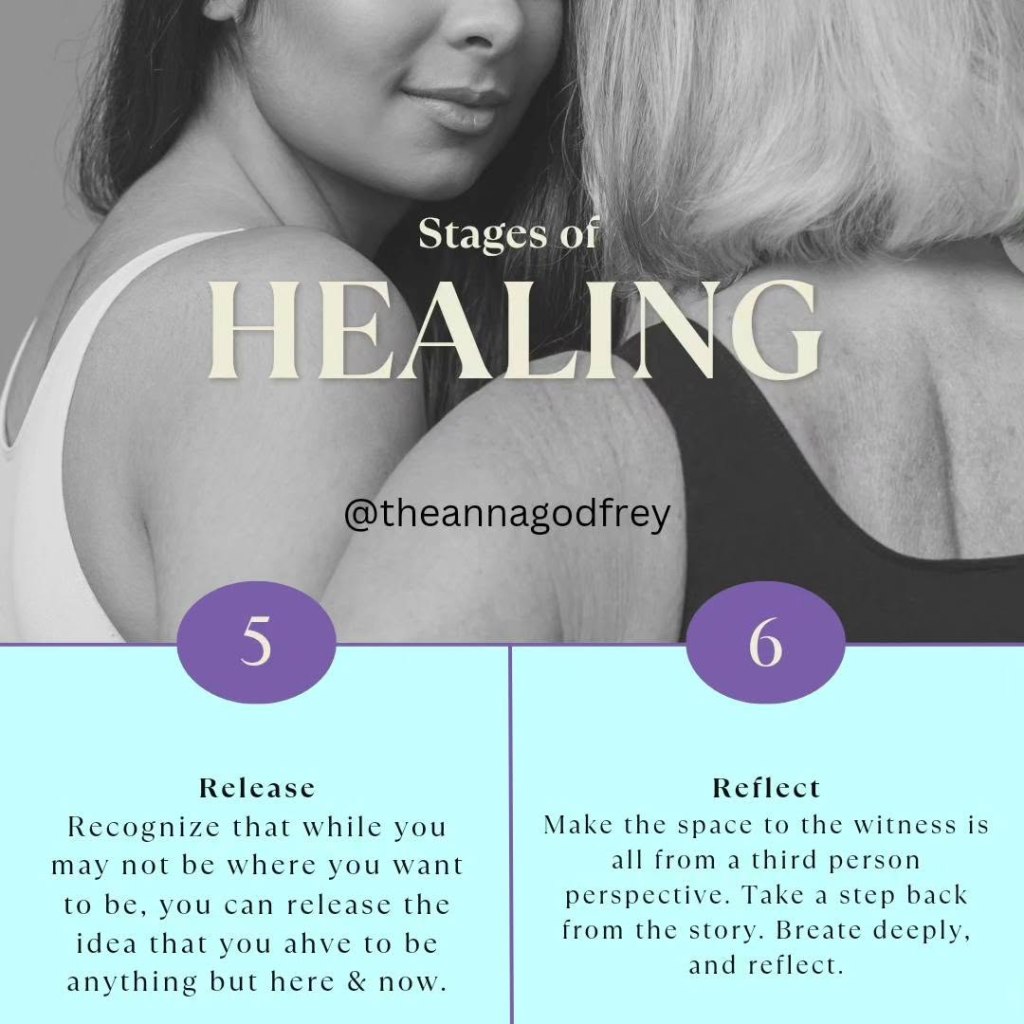
5. Release

True peace comes when we stop fighting the present moment. In the release phase, you recognize that while you may not be exactly where you want to be yet, you can release the heavy expectation that you have to be anything but here and now. You are allowed to just exist as you are today.

6. Reflect

To heal deeply, we have to step out of the chaos of our own minds. Make the conscious space to witness it all from a third-person perspective. Take a step back from the narrative, pull yourself out of the drama of the story, breathe deeply, and simply reflect on how far you’ve come.

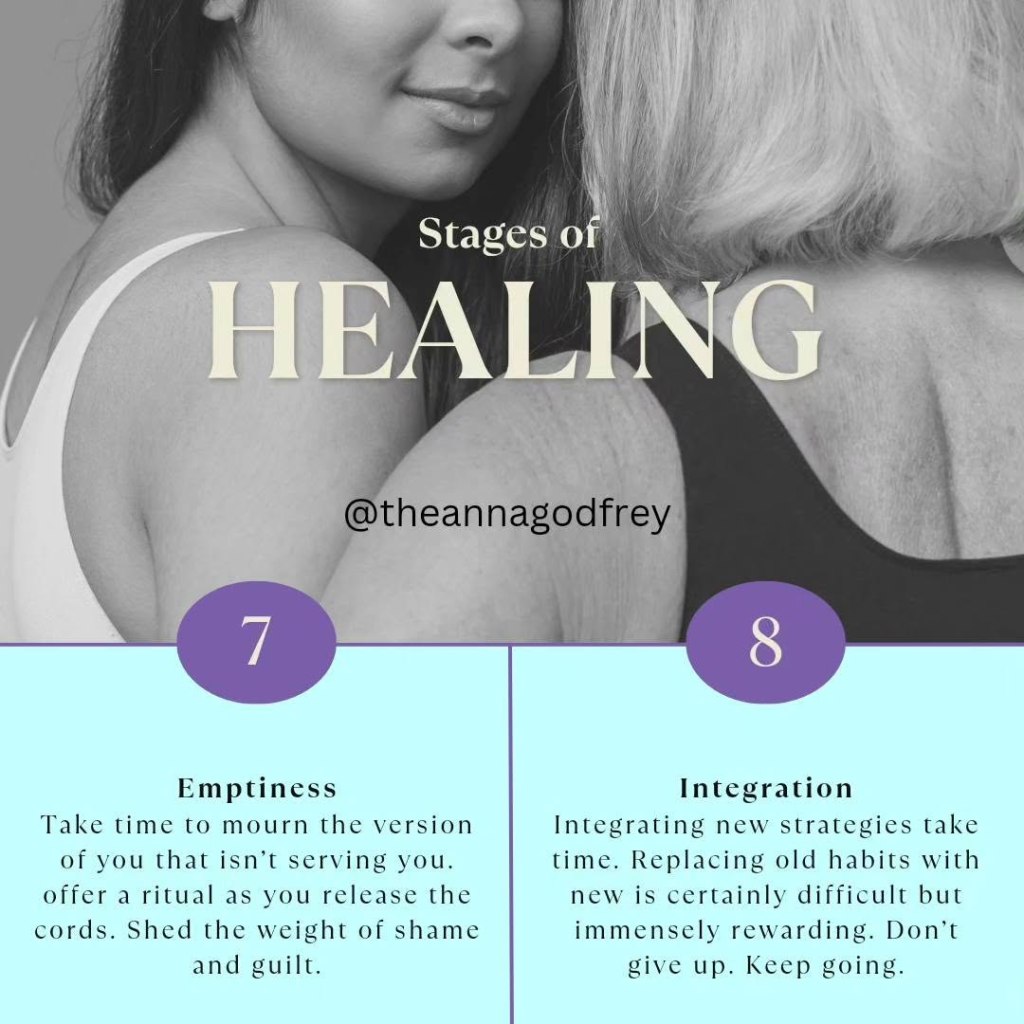
7. Emptiness

Before you can fill your cup with new, vibrant energy, you have to sit with the space left behind. Take the time to mourn the older version of you that is no longer serving your highest good. Offer yourself a quiet ritual as you cut those energetic cords. Shed the heavy weight of shame and guilt; they have no place in your future.

8. Integration

This is where the real work happens. Integrating new, healthy strategies takes time and conscious effort. Replacing lifelong, survival-driven habits with new, mindful practices is undeniably difficult, but it is immensely rewarding. When it feels tough, don’t give up. Keep going.

9. Transform

The final shift. This is where you begin actively making changes where you feel they are most appropriate for your unique journey. Remember: there is absolutely no rush. One single step at a time is enough, because small, consistent changes move mountains.

A Gentle Reminder for Today: Healing takes time. There is no timeline, no schedule, and no competition. Trust the process, honor exactly where your feet are planted today, and above all, be kind to yourself.

How are you nurturing your nervous system through your own healing journey today? Which stage resonates with you the most right now? Let’s connect in the comments.

#HealingJourney #SelfCare #MentalHealth #PersonalGrowth #EmotionalHealing #Mindfulness