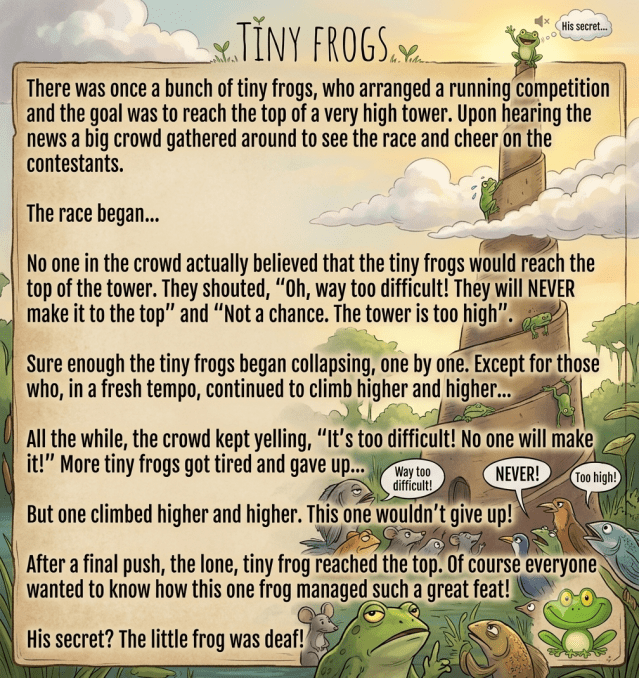
The story holds such a powerful lesson for anyone trying to build a healthier, more intentional life, or pursuing a big goal.
When you decide to make a shift—whether it’s starting a new fitness routine, prioritizing your mental health, or choosing consistency over old habits—the “crowd” will always have something to say. Sometimes that noise comes from well-meaning people, sometimes it’s societal pressure, and honestly, sometimes it’s just the loud, doubtful voice inside our own heads telling us the tower is too high to climb.
If you listen to every voice telling you why it won’t work, why it’s too hard, or why you should just blend back in, you’ll find yourself giving up before you ever see what you’re capable of.
Your growth requires a beautiful kind of selective hearing. Tune out the critics. Tune out the limitations others try to place on you. Protect your peace, anchor yourself in your purpose, and just keep climbing—one step, one round, one mindful breath at a time.
You don’t need the crowd’s permission to reach the top. ✨
Drop a 🧠 or a 🐸 in the comments if you’re choosing to tune out the noise and focus on your alignment this week!
We’ve officially crossed the threshold into the midpoint of the year. Take a deep breath and let that sink in.
A winding mountain path leads toward a sunrise above fog-filled valleys
Back in January, many of us set big, ambitious goals. We made promises about our fitness routines, our nutrition, and our daily habits. But life happens. Routines shift, schedules get chaotic, and sometimes the rigid goals we set in the dead of winter simply don’t align with the reality of our lives today.
Typically, a mid-year check-in can trigger a sense of guilt or pressure to “catch up.” But what if we abandoned the intense, rigid “New Year, New You” mentality entirely?
Instead of pushing harder, mid-year is the perfect time for a gentle, mindful recalibration. It’s an opportunity to assess how your body and mind actually feel right now, and to adjust your sails accordingly. Here is how to hit the reset button with grace, intuition, and kindness toward yourself.
Step 1: Check In with Your Nervous System First
Before you open your planner, look at your calendar, or write down a single new goal, you need to check in with your internal state. True wellness cannot be built on a foundation of chronic stress or exhaustion. If your nervous system is dysregulated—meaning you are living in a constant state of fight-or-flight, anxiety, or burnout—adding a demanding new fitness or wellness goal will only act as another stressor.
Before you redefine what success looks like for the next six months, ask your body a few questions:
How is my energy when I wake up?
Am I holding tension in my jaw, shoulders, or gut?
What does my mind need most right now—more stimulation, or more stillness?
By grounding yourself first, you ensure that your goals come from a place of deep self-care and cellular preservation, rather than a place of perceived inadequacy.
Step 2: Give Yourself Permission to Pivot
Consistency is the holy grail of health, but consistency doesn’t mean rigidity. There is a profound difference between quitting on yourself and making a conscious, mindful pivot.
Take a look at the routines you’ve been trying to force yourself into over the last few months. If your current gym routine leaves you feeling completely drained instead of energized, or if a strict nutrition plan is creating mental fatigue, it’s not a failure—it’s feedback.
Give yourself permission to pivot. If high-intensity workouts aren’t serving your body right now, swap them for consistent boxing classes that let you release stress, or focused strength training sessions coupled with restorative movement. If your daily schedule has transformed, shift your focus to “micro-dosing” your wellness—five minutes of breathwork here, a short walk there. Your wellness routines should support your life, not complicate it.
Step 3: Clear the Mental Clutter (A 5-Minute Exercise)
A cozy sunlit corner with plants, a journal, and a yoga mat by a large window
To step into the second half of the year with clarity, we need to empty our mental cups. When we carry the weight of unmet expectations or outdated goals, we leave no room for new growth.
Try this quick, 5-minute mindfulness exercise today to clear the clutter and reset your focus:
Minute 1-2: Ground and Breathe. Sit comfortably with your feet flat on the floor and close your eyes. Place one hand on your heart and one on your belly. Take three deep, slow inhalations through the nose, expanding your belly, and let them out through the mouth with a sigh. Let your shoulders drop.
Minute 3: The Witness. Bring to mind the goals or expectations you’ve been carrying that feel heavy. Witness them without judgment. Acknowledge the effort you’ve made so far this year.
Minute 4: The Release. As you exhale, mentally release the pressure to be anywhere further along than you are right now. Silently say to yourself: “I release what is no longer serving my health, and I welcome what brings me balance today.”
Minute 5: Setting the Intention. Open your eyes. On a blank piece of paper, write down just one feeling you want to cultivate over the next six months (e.g., Peace, Strength, Vitality, Clarity). Let that single feeling dictate your daily habits moving forward.
Moving Forward with Intention
A vibrant abstract painting of swirling blue and brown hues forming a dynamic vortex
Mountains are moved one small, consistent step at a time. As we navigate the rest of this year, remember that taking care of yourself is a continuous journey of listening, adapting, and trusting the process. Be kind to your body, protect your peace, and move at a pace that honors your health from the inside out.
How does your body feel as we cross into the second half of the year? What is one routine you are giving yourself permission to pivot on today? Let’s connect and support each other in the comments below.
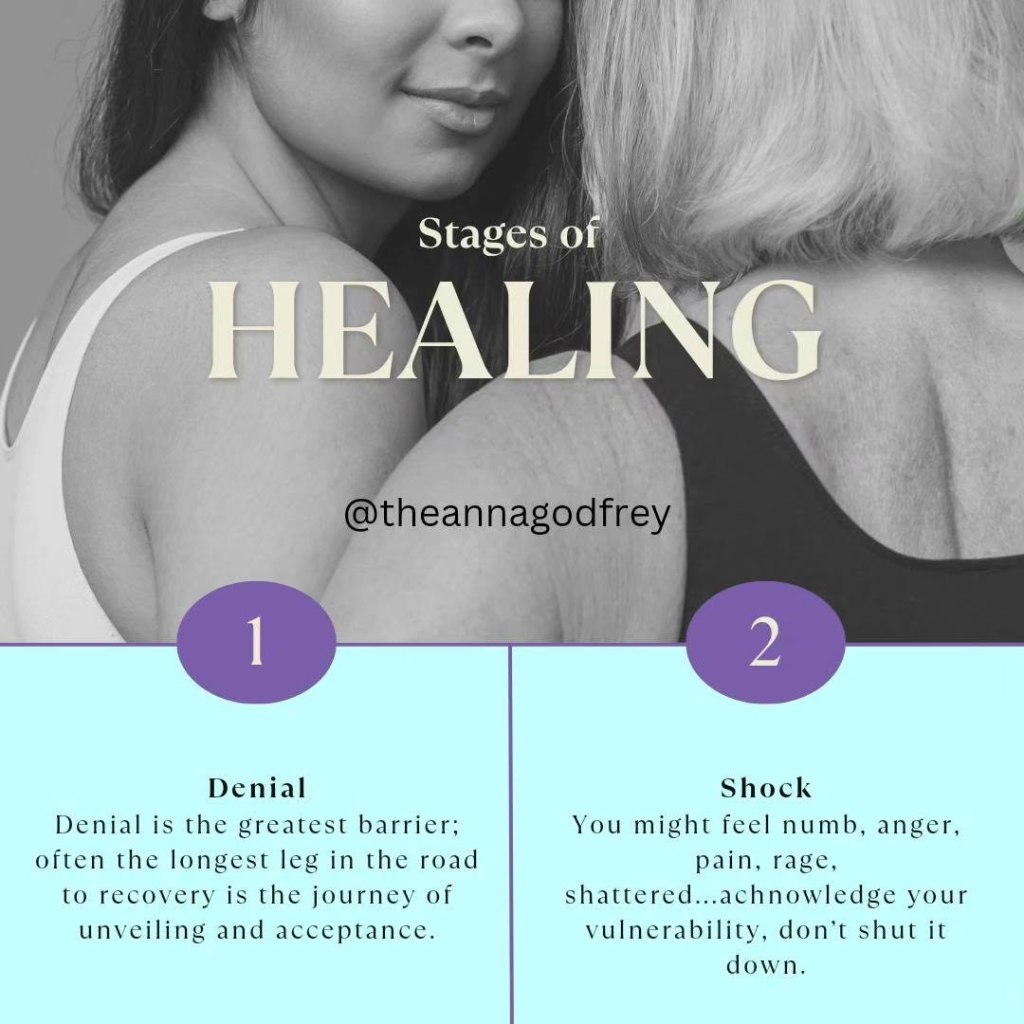
We often talk about healing as if it’s a finish line we cross—a magical moment where the pain disappears, the sky clears, and we are suddenly “fixed.”
But anyone who has ever walked through a season of deep change knows the truth: healing is a journey, not a destination.
It isn’t a straight line. It is an ebb and flow, a continuous cycle of unlearning, shedding, and rebuilding. If you are currently in the thick of your own evolution, wondering why it feels so challenging, it helps to understand the terrain.
A collage of various natural paths winding through different landscapes from forests to deserts and volcanic areas.
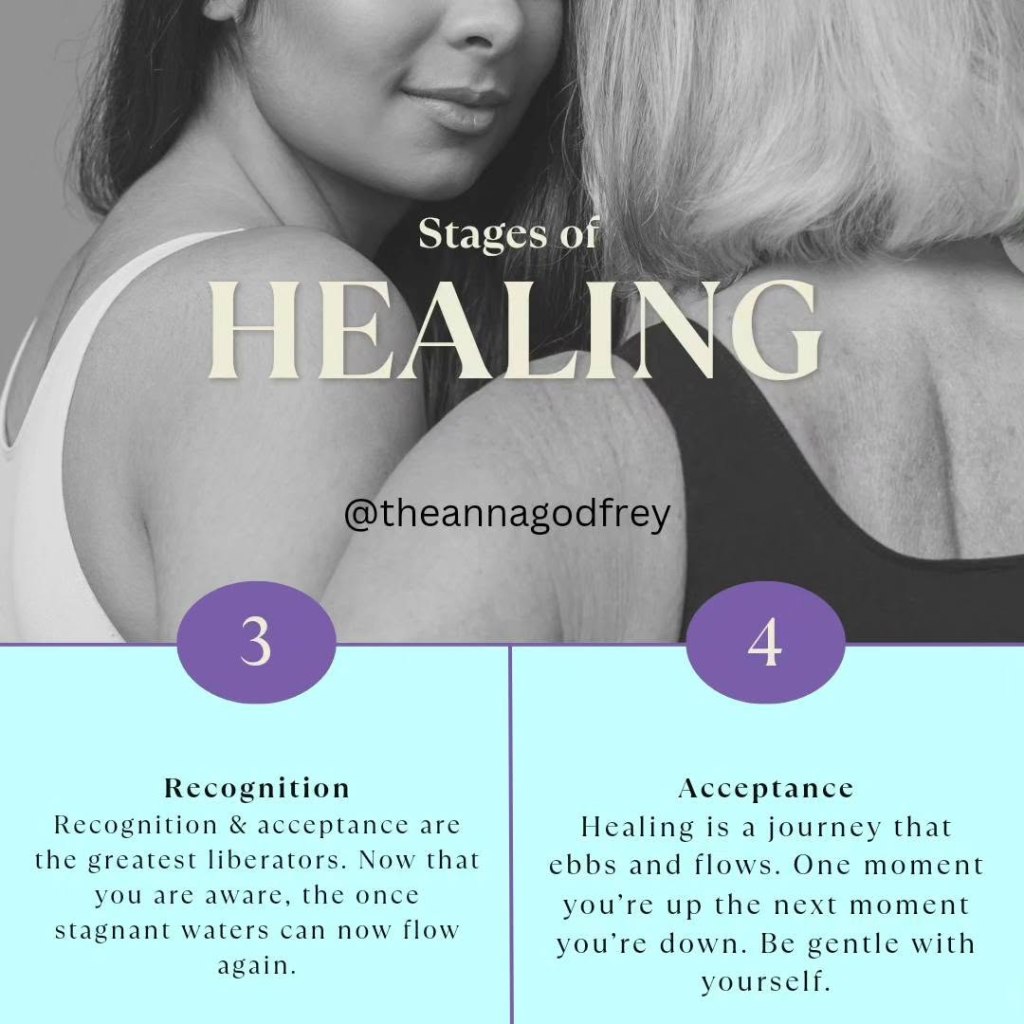
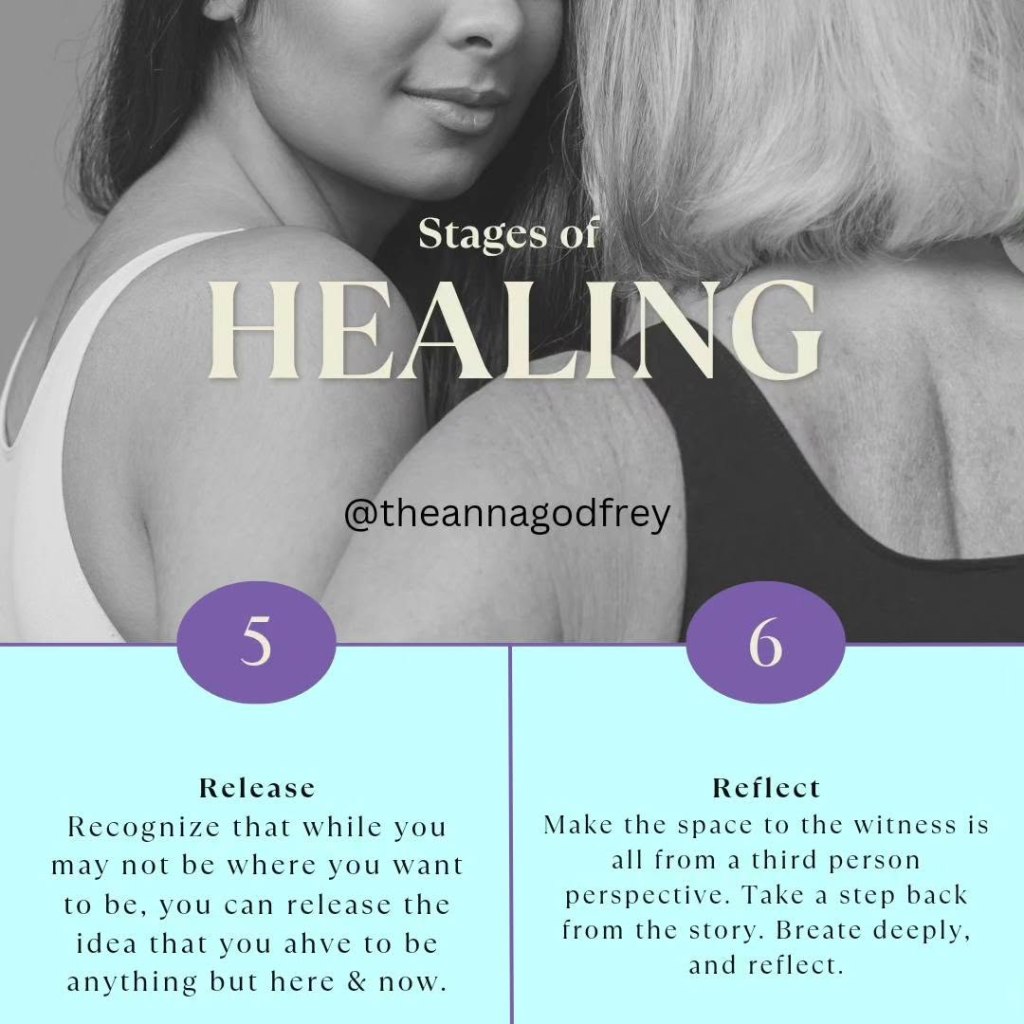
Here are the nine stages we move through as we heal, grow, and reclaim our power.
1. Denial
Denial is a protective blanket our mind throws over us when the truth feels too heavy to bear. It is often the greatest barrier to our evolution. The longest, most exhausting leg of the road to recovery is simply the journey of unveiling the truth and moving toward acceptance. Healing cannot begin until we stop hiding from what is.
2. Shock
When the denial fades, reality hits. In this stage, you might feel entirely numb, or you might be flooded with intense anger, pain, rage, and a feeling of being completely shattered. The key here is survival through allowance: acknowledge your vulnerability; do not shut it down. Let the storm pass through you without judging it.
3. Recognition
This is the turning point. Recognition combined with acceptance are the greatest liberators of the human spirit. The moment you look your reality in the eye and say, “This is what happened, and this is where I am,” the once stagnant waters of your life can finally begin to flow again.
4. Acceptance
Acceptance doesn’t mean you love what happened; it means you stop fighting it. This stage is a fluid journey that ebbs and flows. One moment you are standing strong on the mountaintop, and the next moment you feel down in the valley again. This is normal. Be gentle with yourself during the dips.
5. Release
True peace comes when we stop fighting the present moment. In the release phase, you recognize that while you may not be exactly where you want to be yet, you can release the heavy expectation that you have to be anything but here and now. You are allowed to just exist as you are today.
6. Reflect
To heal deeply, we have to step out of the chaos of our own minds. Make the conscious space to witness it all from a third-person perspective. Take a step back from the narrative, pull yourself out of the drama of the story, breathe deeply, and simply reflect on how far you’ve come.
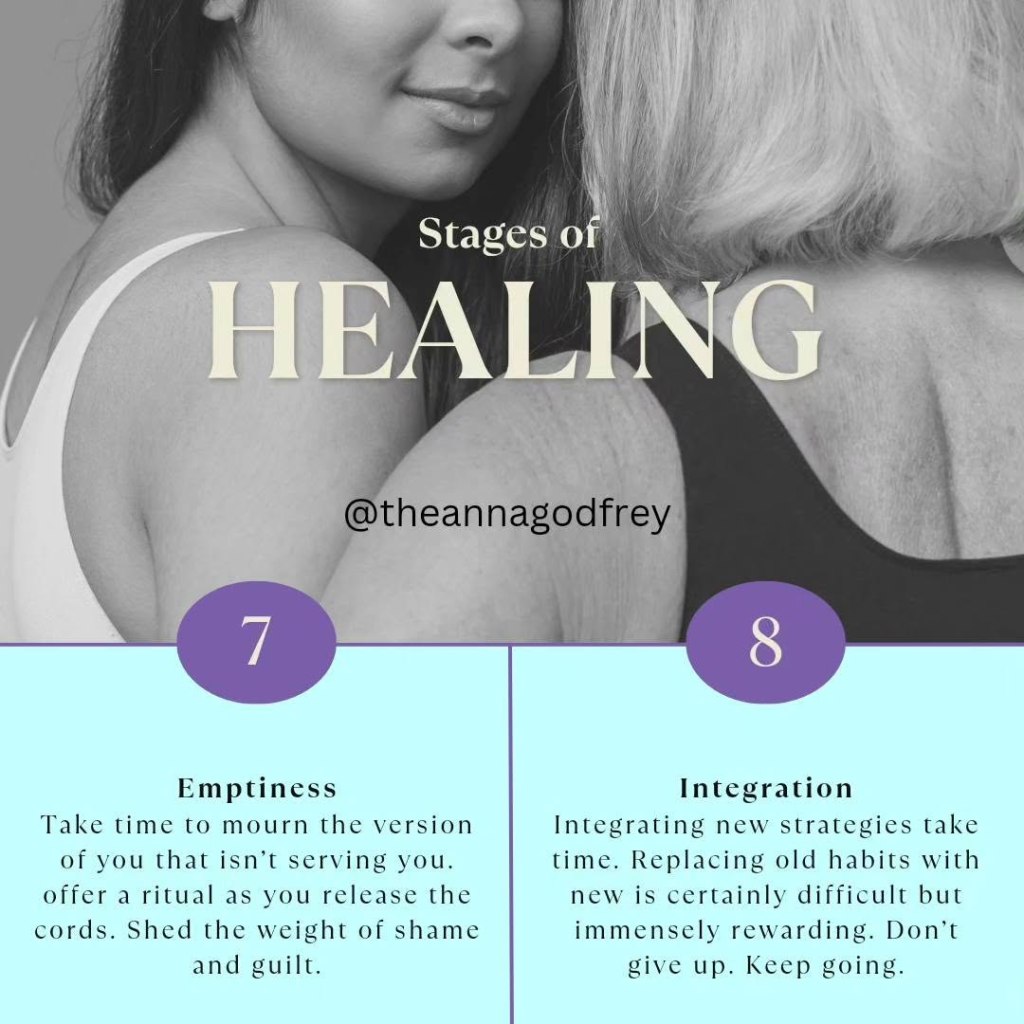
7. Emptiness
Before you can fill your cup with new, vibrant energy, you have to sit with the space left behind. Take the time to mourn the older version of you that is no longer serving your highest good. Offer yourself a quiet ritual as you cut those energetic cords. Shed the heavy weight of shame and guilt; they have no place in your future.
8. Integration
This is where the real work happens. Integrating new, healthy strategies takes time and conscious effort. Replacing lifelong, survival-driven habits with new, mindful practices is undeniably difficult, but it is immensely rewarding. When it feels tough, don’t give up. Keep going.
9. Transform
The final shift. This is where you begin actively making changes where you feel they are most appropriate for your unique journey. Remember: there is absolutely no rush. One single step at a time is enough, because small, consistent changes move mountains.
A Gentle Reminder for Today: Healing takes time. There is no timeline, no schedule, and no competition. Trust the process, honor exactly where your feet are planted today, and above all, be kind to yourself.
How are you nurturing your nervous system through your own healing journey today? Which stage resonates with you the most right now? Let’s connect in the comments.
You must be logged in to post a comment.