🧘♀️ Feeling Lost in the Maze of Life? There’s an App (and it’s Free! 😉)
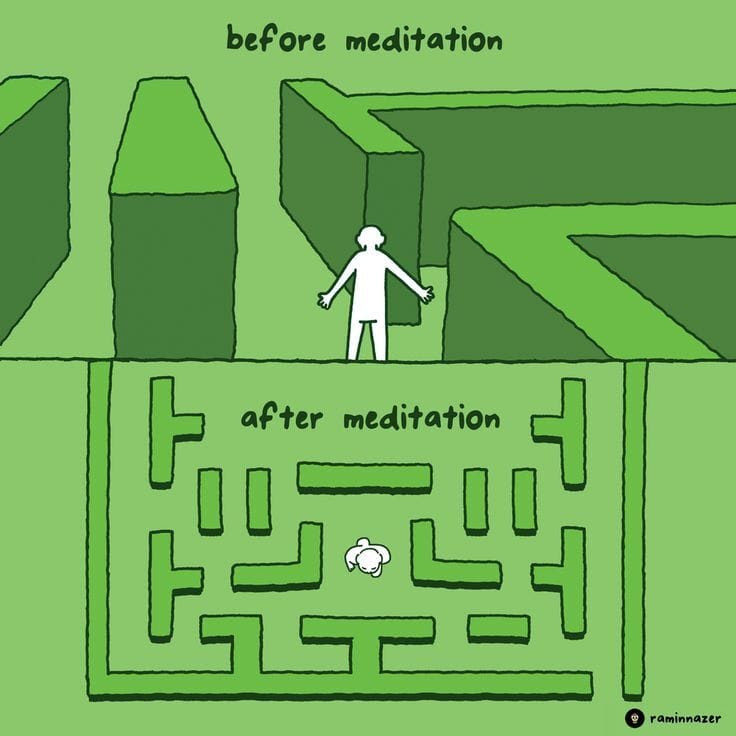
Check out this hilarious (and SO relatable) pic by Ramin Nazer! Ever feel like the “before meditation” dude? Arms flailing, totally lost in the mental hedge maze? 🙋♀️🙋♂️ We’ve all been there!
But look what happens “after meditation”! Suddenly, the path becomes clear, the noise quiets down, and you’ve got a little inner GPS guiding you through. Pretty cool, right? 😎
It might seem too simple to just sit and breathe, but the science backs it up! 👇
🧠 Brain Boost: Studies have shown that regular meditation can actually change your brain structure, increasing grey matter in areas associated with learning, memory, and emotional regulation. Talk about an upgrade!
😌 Stress Buster: Meditation helps lower cortisol, your body’s main stress hormone. Think of it as a mini-vacay for your nervous system. Ahhh…
✨ Focus Power: Training your mind to focus during meditation can translate to better concentration in your daily life. Say goodbye to those squirrel moments! 🐿️➡️🧠
😴 Sleep Savior: If racing thoughts keep you up at night, meditation can help calm your mind and pave the way for some sweet Zzz’s.
So, ditch the mental maze madness and give meditation a try! You don’t need to sit for hours or chant like a guru (unless you want to!). Even 5-10 minutes a day can make a difference.
Fun Fact: Did you know that meditation has been practiced for thousands of years across various cultures and traditions? It’s a time-tested tool for well-being!
Your mission, should you choose to accept it: Take 5 minutes today to just breathe. Notice your thoughts without judgment, like clouds passing by. You might just surprise yourself at how quickly that inner maze starts to clear. ✨
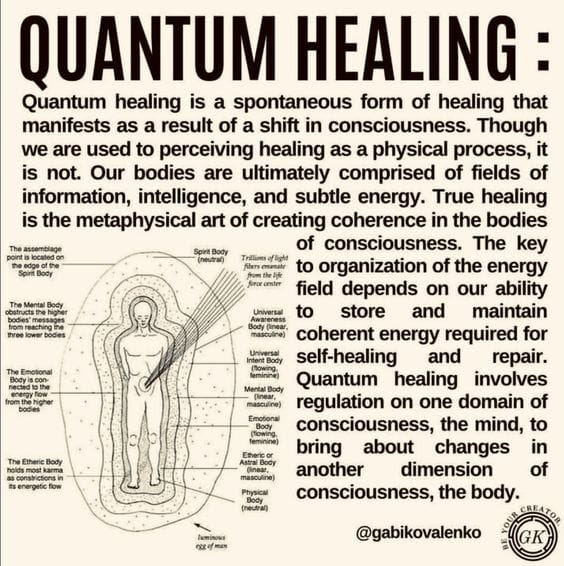
The term “quantum healing” often evokes a sense of mystery and possibility, suggesting a form of healing that goes beyond conventional physical approaches. The image you shared describes it as “a spontaneous form of healing that manifests as a result of a shift in consciousness.” This concept taps into the idea that our bodies are more than just physical matter; they are intricate fields of information, intelligence, and subtle energy. But what does this actually mean, and what does the scientific community say about it? Let’s explore the theories and perspectives surrounding quantum healing.
The Core Idea: Coherence in the Bodies of Consciousness
According to the image, true healing is presented as “the metaphysical art of creating coherence in the bodies of consciousness.” It suggests that the organization of our energy field is crucial for self-healing and repair. This framework posits that we are not simply physical beings but possess layers of interconnected “bodies,” as illustrated:
Physical Body: The tangible body we experience.
Etheric/Astral Body: Described as flowing and feminine, potentially related to our vitality and emotions.
Emotional Body: Associated with our feelings.
Mental Body (Linear, Masculine): Linked to our thoughts and linear processing.
Universal Mental Body (Flowing, Feminine): Perhaps connected to intuition and a broader understanding.
Spirit Body (Neutral): Seen as encompassing the other bodies, where the “assemblage point” is located.
The theory suggests that imbalances or incoherence in these subtle bodies can manifest as physical ailments. Quantum healing, therefore, aims to restore harmony and coherence at these deeper levels, leading to healing in the physical body. The image mentions that quantum healing involves “regulation on one domain of consciousness, the mind, to bring about changes in another dimension of consciousness, the body.”
The Role of Consciousness:
A central tenet of quantum healing is the power of consciousness. Proponents suggest that focused intention, visualization, and a shift in awareness can influence our body’s energy fields and trigger the self-healing process. This aligns with some research in the mind-body connection, such as the impact of stress on physical health and the potential benefits of mindfulness and meditation.
“Trillions of Light Fibers”: Information and Energy Transfer?
The image refers to “trillions of light fibers” that “emanate from the life force center.” This seems to suggest a network through which information or energy flows within these subtle bodies. While not directly recognized by conventional science, this concept resonates with ideas in some energy medicine modalities that propose the existence of biofields or subtle energy systems within the body.
Scientific Perspectives and Theories:
It’s important to note that quantum healing, as described in the image, is largely considered a pseudoscience by the mainstream scientific community. The existence of the “bodies of consciousness” and the mechanisms of energy transfer described are not supported by empirical evidence or established scientific principles.
However, the underlying idea of the mind-body connection is a well-researched area. Studies have shown that psychological factors like stress, emotions, and beliefs can significantly impact physical health. For example:
The Placebo Effect: This demonstrates the powerful influence of the mind on physical outcomes. Believing in a treatment can lead to real physiological changes, even if the treatment itself is inert.
Psychoneuroimmunology (PNI): This field explores the interactions between the nervous system, the immune system, and the mind, showing how psychological states can affect immune function and disease processes.
Mindfulness and Meditation: Research suggests these practices can reduce stress, improve immune function, and even alter brain structure and function.
While these fields acknowledge the profound impact of consciousness on health, they operate within a biological and neurological framework, rather than the metaphysical model presented in the image.
The Quantum Analogy:
The term “quantum” in “quantum healing” is often used loosely and does not typically refer to the principles of quantum physics in a direct or scientifically accurate way in this context. Quantum physics deals with the behavior of matter and energy at the atomic and subatomic levels, which operates under very different rules than the macroscopic biological systems of the human body.
In Conclusion:
Quantum healing, as depicted in the image, presents a fascinating perspective on healing that emphasizes the role of consciousness and subtle energy fields. While the specific mechanisms described are not currently supported by mainstream scientific evidence, the broader concept of the mind-body connection is a significant area of scientific inquiry. Understanding the interplay between our thoughts, emotions, and physical health is a valuable pursuit, even if the explanations differ.
Have you ever felt completely overwhelmed by a craving? That intense pull towards something you know, deep down, you might regret later? Whether it’s the urge to reach for that extra snack, scroll endlessly on social media, or engage in any other habit you’re trying to break, these urges can feel like powerful forces dictating your actions.
For so long, the common advice has been to fight these urges – to grit your teeth, use sheer willpower, and push through. But what if there was a different way? A way that acknowledges the intensity of these feelings without getting swept away by them?
Enter the concept of “Urge Surfing.”
Imagine an ocean wave. It starts small, gradually builds in intensity until it reaches a powerful peak, and then eventually, it begins to subside, gently rolling back to calm waters. Our urges often behave in a similar way. They have a beginning, a middle, and an end.
Understanding the Anatomy of an Urge Wave:
As the image beautifully illustrates, urge surfing involves recognizing and riding these waves of desire:
The Trigger: Something sparks the urge. It could be a thought, a feeling, a place, a person, or even a sensory experience like a smell or a taste. You suddenly feel that familiar pull.
The Urge Rise: This is when the urge starts to intensify. You might notice physical sensations like a racing heart, sweating, or fast breathing, as your mind becomes more and more focused on the desired behavior.
The Peak: This is the most intense point of the urge. It can feel all-consuming, like it will never go away. You might experience strong emotional and physical discomfort.
The Fall: Just like a wave, the urge will eventually start to lose its power. The intensity begins to fade, and you start to feel a sense of relief, both mentally and physically.
The Counterintuitive Power of Riding the Wave:
Our natural instinct when faced with an intense urge is to fight it, to push it away with all our might. But often, this resistance can actually amplify the urge, creating an internal struggle that leaves us feeling drained and more likely to give in eventually.
Urge surfing offers a different approach: acceptance and observation. Instead of fighting the urge, you acknowledge its presence and observe it without judgment, much like a surfer observes and rides a wave.
Why Does This Work?
It Acknowledges Reality: Urges are a normal part of the human experience. Trying to suppress them entirely can be exhausting and often backfires.
It Highlights Temporality: By observing the urge, you begin to notice its natural ebb and flow. You realize that even the most intense urges are temporary and will eventually pass.
It Reduces the Power Struggle: When you stop fighting, you reduce the internal conflict, which can lessen the intensity and distress associated with the urge.
It Builds Self-Awareness: You become more attuned to your triggers, the physical sensations of the urge, and how it changes over time.
How to Practice Urge Surfing:
Identify the Trigger: What situations, thoughts, or feelings tend to bring on the urge?
Notice the Urge Rise: Pay attention to the physical and emotional sensations as the urge intensifies. Where do you feel it in your body? What thoughts are going through your mind?
Ride the Peak: Instead of acting on the urge, simply observe it. Notice its intensity without judgment. Remind yourself that this feeling is temporary. Breathe deeply.
Observe the Fall: As the urge begins to subside, notice the shift in your sensations and thoughts. Acknowledge your ability to ride it out.
More Than Just Waves:
Think of it like riding out a strong emotion, like sadness or anger. If you try to suppress it completely, it might fester. But if you allow yourself to feel it, observe it, and let it run its course, it will eventually dissipate.
Urge surfing is a skill that takes practice, but it offers a powerful alternative to the exhausting battle of constant willpower. It’s about learning to relate to our urges with curiosity and acceptance, knowing that even the biggest waves eventually return to calm waters.
You must be logged in to post a comment.