August 1-2 2026 | GaiaSphere Event Center | Boulder, CO
Join 10 leading researchers, scientists, and bestselling authors for a powerful exploration of ancient civilizations, groundbreaking discoveries, and new insights reshaping our understanding of humanity’s past and potential.
The Ancient Civilizations Conference 2026 brings this distinguished lineup of experts together to examine emerging evidence that challenges long-held assumptions and reveals a more complex story of our origins.
Gregg Braden
Freddy Silva
Robert Edward Grant
William Henry
Theresa Bullard-Whyke, Ph.D.
Billy Carson
Jaime Maussan
Filippo Biondi, Ph.D.
Cassie Coppersmith
Zdeněk Sýkora
Gather in person at the GaiaSphere in Boulder, Colorado, or join via livestream, and connect with these respected voices as they uncover new evidence and insights into the mysteries of ancient civilizations.
This once-a-year event is your opportunity to explore:
✨ Time, Consciousness & Human Potential in Ancient Cultures
🔮 Ancient Technologies Tied to Earth’s Energy Systems
🌀 A Hidden Process & Blueprint Behind Human History
🌐 A Hidden Global Network of Underground & Symbolic Systems
✨ Whether you’re seeking insight into humanity’s origins, a fresh perspective on ancient knowledge, or a deeper connection to the forces that shaped our world, this experience will challenge what you think you know and reveal the hidden patterns of our shared past.
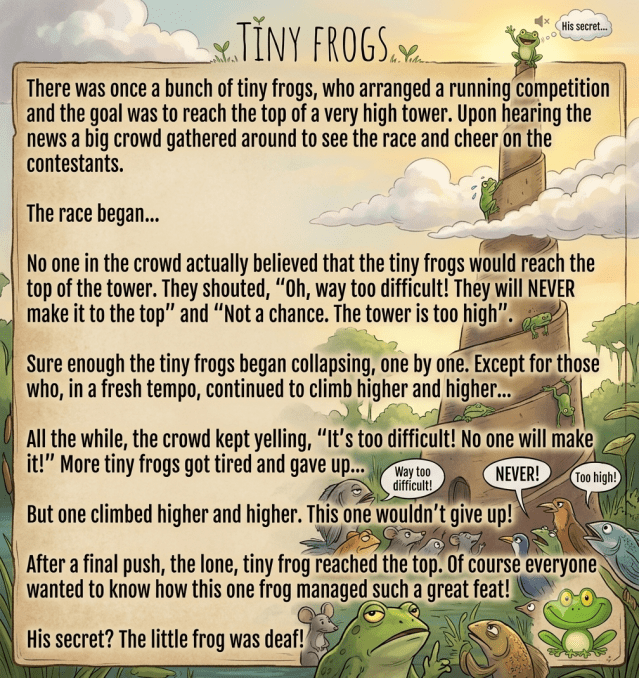
The story holds such a powerful lesson for anyone trying to build a healthier, more intentional life, or pursuing a big goal.
When you decide to make a shift—whether it’s starting a new fitness routine, prioritizing your mental health, or choosing consistency over old habits—the “crowd” will always have something to say. Sometimes that noise comes from well-meaning people, sometimes it’s societal pressure, and honestly, sometimes it’s just the loud, doubtful voice inside our own heads telling us the tower is too high to climb.
If you listen to every voice telling you why it won’t work, why it’s too hard, or why you should just blend back in, you’ll find yourself giving up before you ever see what you’re capable of.
Your growth requires a beautiful kind of selective hearing. Tune out the critics. Tune out the limitations others try to place on you. Protect your peace, anchor yourself in your purpose, and just keep climbing—one step, one round, one mindful breath at a time.
You don’t need the crowd’s permission to reach the top. ✨
Drop a 🧠 or a 🐸 in the comments if you’re choosing to tune out the noise and focus on your alignment this week!
Does self-care ever feel like just another demanding item on your endless to-do list?
A journal and cup of tea rest on a yoga mat by a sunny window overlooking a garden.
Maybe you know you are running on empty and desperately need a reset, but the sheer volume of wellness advice out there leaves you feeling overwhelmed. When every influencer is telling you to adopt a 10-step morning routine, it’s easy to freeze, do nothing, and remain stuck in burnout.
True self-care shouldn’t be stressful. It is about understanding what your body, mind, and nervous system actually need in the present moment.
To simplify your approach, try looking at wellness through the lens of The Seven Pillars of Self-Care. By breaking it down, you can accurately diagnose where you are feeling depleted instead of trying to overhaul your entire life at once.
The Seven Pillars of Self-Care
A serene mountain valley with a winding river glows under a colorful sunset.
1. Mental: Cultivate a clean, resilient mindset through daily mindfulness, continuous learning, and curiosity. It’s about how you talk to yourself when no one else is listening.
2. Emotional: Honor your feelings and protect your inner peace with healthy coping strategies, journaling, and the space to process life’s challenges without judgment.
3. Physical: Nourish your biology. This means supporting cellular energy, prioritizing high-quality sleep, maintaining optimal hydration, and moving your body with intention—whether that’s a heavy gym session or a restorative walk.
4. Environmental: Optimize the spaces and places around you. Your physical surroundings directly impact your nervous system; a calm, decluttered workspace or home creates a calm mind.
5. Spiritual: Engage in practices that anchor you and offer a deeper sense of meaning, alignment, and connection to something larger than yourself.
6. Recreational: Make unnegotiable time for pure play, hobbies, and new experiences. Step away from the “productivity mindset” and do something simply because it brings you joy.
7. Social: Build a supportive community. Cultivate deep, meaningful relationships while maintaining the beautiful, necessary boundaries that protect your time and energy.
Shift from Perfect Balance to Present Awareness
Looking at this list, it’s easy to think you need to achieve a flawless, 50/50 balance across all seven areas simultaneously. Let’s release that pressure right now. Perfection is a myth.
Wellness ebbs and flows with the seasons of your life. Instead of trying to do everything at once, choose one single area to focus on this week, or even this month. When your nervous system feels stable and integrated in that category, you can gently expand your focus to another.
The secret is simply noticing which one or two areas are currently shouting for your attention. When we ignore a specific pillar for too long, it begins to drag the other areas down with it.
Prioritize Your Vitality, Especially in the Rush
Taking care of your unique biology and peace of mind is the ultimate foundation for your overall health. Be incredibly intentional about anchoring yourself—especially during the crazy, busy times. That is exactly when your cells and your soul need it the most.
Take one mindful step today. You are entirely worth the investment.
Which pillar is calling your name right now? Which one will you be intentionally nurturing this week? Let’s connect and support each other in the comments below!
For the high-achievers, the go-getters, and the fitness enthusiasts, the mantra of modern life is usually more. Move faster. Push harder. Crush another high-intensity gym session. Conquer the next item on the to-do list. We treat our bodies and minds like machines built for endless output.
A tranquil sunrise over a misty mountain lake with a dock and boat
But if you are always redlining your engine, eventually, it’s going to overheat.
If you are someone who thrives on high-intensity fitness—whether that’s hitting the heavy bag in a grueling boxing class, crushing a heavy lifting session, or managing a packed professional schedule—downtime can feel incredibly uncomfortable. In fact, sitting still can bring on a sneaky wave of guilt. We’ve been conditioned to believe that rest is passive, lazy, or a waste of time.
It’s time to reframe that narrative. Rest is not the absence of progress; it is the engine that drives it. If you want to perform at your absolute peak, you have to master the art of slowing down to speed up. Here is the science of why intentional recovery and mindfulness are the ultimate active tools for high performance.
1. The Cellular Science: What Happens When You Hit Pause
When you push yourself through a intense workout or a high-stress workday, you are actively tearing down muscle tissue and draining your neurological reserves. You don’t actually build strength, stamina, or mental sharpess during the hustle—you build them during the recovery.
When you consciously hit pause and transition your nervous system out of fight-or-flight and into the parasympathetic “rest and digest” state, your body triggers a wave of biological magic:
Cellular and Tissue Repair: Human Growth Hormone (HGH) is released, initiating deep protein synthesis to repair muscle tears, making you stronger and more resilient for your next session.
Mitochondrial Reboot: Your cellular powerhouses—the mitochondria—recharge, ensuring your baseline energy levels stay high and stable rather than crashing in the afternoon.
The Brain’s Night Shift: While you rest, your brain activates its glymphatic system, essentially “flushing out” cellular waste and metabolic debris accumulated throughout the day. This clears the mental fog and protects your cognitive longevity.
Without intentional rest, you aren’t training hard—you are simply breaking your body down without giving it the raw materials to rebuild.
A glowing network of neural cells illuminated with fluorescent colors under a microscope
2. Overcoming the Guilt of “Doing Nothing”
For high-achievers, the hardest part of rest isn’t finding the time; it’s managing the mental chatter that tells us we should be doing something else. We equate our self-worth with our productivity.
To overcome the guilt of slowing down, you must reframe rest as a strategic discipline.
Think of it this way: athletes don’t view their recovery days as “lazy time”—they view them as an essential component of their training protocol. Sitting in meditation, taking an evening off, or prioritizing a solid night of sleep isn’t “doing nothing.” It is an active investment in your next victory. When you step away from the noise, you aren’t quitting the race; you are pulling into the pit stop to refuel so you can hit the track faster and stronger than before.
3. How Meditation Upgrades Executive Focus and Physical Stamina
If you want a tangible biohack to improve both your physical output and your mental clarity, look no further than a dedicated meditation practice. Mindfulness isn’t just about finding peace; it is a serious performance enhancer.
Sharper Executive Focus: Meditation is weightlifting for your brain. By practicing the art of bringing your attention back to the present moment (your breath, a sound, or a sensation), you strengthen the prefrontal cortex—the area of the brain responsible for decision-making, emotional regulation, and razor-sharp focus. A few minutes of daily meditation trains you to stay calm and analytical when high-stakes professional pressure hits.
Increased Physical Stamina: High-intensity fitness requires immense mental endurance. When your muscles are burning during a tough round or a final set, your brain’s natural reaction is to panic and tell you to stop. A consistent mindfulness practice teaches you how to sit with discomfort, observe it without reacting, and regulate your breathing. By staying mentally calm under physical stress, you lower your perceived exertion and unlock a completely new level of physical stamina.
Slow Down to Speed Up
A trail runner takes a break on a rock overlooking mountains at sunset
True high performance is built on contrast. You cannot have a powerful, explosive output without a deep, grounded input.
This week, challenge yourself to honor your recovery with the same intensity that you bring to the gym or the office. Block out time for a 5-minute meditation, protect your sleep, and give your body the space it needs to integrate your hard work. You’ll quickly find that when you give yourself permission to slow down, you return to your life with an unstoppable momentum.
Do you struggle to sit still, or have you mastered the art of the strategic reset? Let me know how you balance high-intensity with high-recovery in the comments!
Summer is finally here, and with it comes a beautiful shift in energy. The days are longer, the air is warmer, and our schedules naturally open up for vacations, backyard barbecues, and spontaneous evening patio hangs. It is a season meant for joy and connection.
A woman enjoys infused water while journaling in a lush garden
But if you are someone who thrives on a structured wellness routine, summer can also bring a sneaky wave of anxiety.
Suddenly, your carefully planned gym hours conflict with family outings. Your meticulous meal prep is replaced by travel food and seasonal treats. Your sleep schedule shifts with the late sunset. It’s incredibly easy to look at a disrupted calendar and think, “Well, my routine is ruined. I guess I’ll just start over in September.”
But your body doesn’t hit pause for the summer, and your wellness shouldn’t either. The secret to navigating this season isn’t rigid perfectionism—it’s adaptive biohacking. Here is how to maintain your cellular energy, protect your momentum, and enjoy every single bit of summer without losing your progress.
1. Shift from “All-or-Nothing” to a “Consistency-Based” Lifestyle
The biggest enemy of summer wellness isn’t a missed workout or a hot dog at a picnic; it is the “all-or-nothing” mindset. We often fall into the trap of believing that if we can’t do our full 60-minute gym routine or eat a flawlessly clean diet, the entire day is a wash.
This summer, let’s shred that rulebook and embrace a consistency-based lifestyle.
Wellness isn’t a test you pass or fail; it’s a relationship you maintain with your body. When routines fly out the window, consistency looks like asking yourself: “What is the best choice I can make for my vitality right now, given the circumstances?” Shifting your mindset from perfection to momentum keeps your nervous system out of shame-mode and ensures you stay connected to your health goals all season long.
A woman stretches her leg during an outdoor workout on a sunny morning
2. “Micro-Dosing” Your Wellness Routine
When you don’t have hours to dedicate to your usual wellness pillars, it’s time to biohack your schedule by micro-dosing your habits. Micro-dosing means breaking your wellness practices down into potent, bite-sized increments that keep your momentum alive without consuming your day.
Can’t make it to your favorite 60-minute fitness class or gym session?
Put on your wraps and do a quick, high-intensity 15-minute boxing shadow-work or heavy bag session right in your garage.
Take a fast-paced 10-minute walk around the block after dinner to support your glucose levels and digestion.
Don’t have time for a deep-dive morning routine before a busy day with family?
Do a 5-minute grounded meditation in your seat before anyone else wakes up to regulate your nervous system.
These micro-doses take very little time, but they send a powerful signal to your brain and cells that your health is still a priority. They keep your habits warm so you never have to start back at zero.
3. Support Cellular Wellness and Hydration from the Inside Out
Flowing water intertwines with glowing molecular structures in a forest stream
High-activity summer months and warmer weather place a unique demand on your biology. If you want to keep your energy high and avoid that sluggish, afternoon summer slump, you need to support your body at the cellular level.
Elevate Your Hydration: Drinking water is crucial, but true cellular hydration requires electrolytes. When you sweat, you lose vital minerals like sodium, potassium, and magnesium. To keep your cellular pumps working optimally and support your metabolic health, add high-quality electrolytes to your morning water. This keeps your brain sharp, prevents headaches, and maintains muscle stamina.
Prioritize Cellular Recovery: With late summer nights and early sunrises, your sleep might take a hit. Support your mitochondria (the powerhouses of your cells) by prioritizing nutrient-dense supplementation, supporting your gut health, and getting a few minutes of direct, natural sunlight into your eyes first thing in the morning to anchor your circadian rhythm.
Enjoy the Journey
Summer is a beautiful reminder that life ebbs and flows. You don’t need a rigid schedule to be healthy, vibrant, and aligned. Trust the baseline you’ve built, focus on small daily wins, and remember that consistency is about showing up for yourself in whatever capacity you can today.
Lace up your sneakers, grab your water, and go enjoy the sunshine. You’ve got this.
How are you micro-dosing your wellness today? Let me know in the comments below!

















You must be logged in to post a comment.