The Role of Karma in the Six Realms of Existence

The realms are not just random destinations; they are integral components that illustrate the core mechanics and consequences of Samsara. Here’s how they relate to the overall concept:  

  • Manifestations of Karma: The six realms are, fundamentally, tangible (though symbolic) manifestations of karma. Our past actions, driven by the three poisons (ignorance, attachment, and aversion), create karmic imprints that ripen into rebirth in one of these realms. Positive actions tend to lead to rebirth in the higher realms (gods, demigods, humans), while negative actions lead to rebirth in the lower realms (animals, hungry ghosts, hell beings). The specific nature of our karma dictates the specific experiences within each realm.  
  • Illustrating the Spectrum of Suffering: The realms vividly depict the spectrum of suffering inherent in cyclic existence. From the fleeting pleasures of the god realm to the intense torment of the hell realm, they showcase the various forms of dissatisfaction, pain, and impermanence that characterize Samsara. Even the “happier” realms are ultimately unsatisfactory because they are transient and do not offer lasting liberation.
  • Highlighting the Driving Forces: The characteristics of each realm reflect the dominance of the three poisons. For instance, the god realm can be fueled by past positive karma but hindered by pride and attachment to pleasure. The demigod realm is driven by jealousy and aggression. The lower realms are clearly dominated by ignorance, craving, and hatred. Thus, the realms visually represent how these negative mental states perpetuate the cycle.
  • Emphasizing Impermanence: The cycle of rebirth through these realms underscores the fundamental principle of impermanence. No realm is eternal. Beings are born into a realm, experience its particular conditions, exhaust the karma that led them there, and then die and are reborn into another realm according to their remaining karma. This constant movement through different states of being highlights the transient nature of all conditioned existence within Samsara.
  • Providing a Framework for Understanding Suffering and Liberation: The realms offer a framework for understanding the nature of suffering and the potential for liberation. By observing the suffering inherent in each realm, particularly the lower ones, the urgency for seeking a way out of this cycle becomes clearer. The human realm, with its unique blend of suffering and opportunity for spiritual practice, becomes especially significant as the potential gateway to liberation from all the realms of Samsara.  

In essence, the realms are not just places to be; they are dynamic expressions of the karmic process, the spectrum of suffering, the power of negative emotions, the reality of impermanence, and the very cycle that spiritual practitioners aim to transcend. They provide a vivid and relatable (even if symbolic) picture of what it means to be caught in Samsara and why liberation is the ultimate goal.  

Exploring the Six Realms of Samsara: A Guide

Alright, let’s take a closer look at the six realms depicted in the Wheel of Samsara. These realms represent different states of existence or planes of consciousness that beings cycle through based on their karma. It’s important to remember that these aren’t necessarily physical places but rather symbolic representations of different qualities of experience.

Here’s a breakdown of each realm:

1. The Realm of Gods (Devas): The Realm of Bliss and Pride

  • Characteristics: This realm is often depicted as a heavenly abode filled with pleasure, luxury, and long lifespans. Beings in this realm experience great joy, beauty, and power.
  • The Downside: Despite the immense happiness, this realm is not permanent. Eventually, their good karma will be exhausted, and they will be reborn into a lower realm. Furthermore, their very happiness can lead to complacency and a lack of motivation to pursue spiritual liberation. They can become attached to their blissful existence and fail to recognize the suffering inherent in Samsara. Pride in their elevated status can also be a significant obstacle.
  • Key Emotion: Pride, attachment to pleasure.

2. The Realm of Demigods (Asuras): The Realm of Jealousy and Conflict

  • Characteristics: This realm is characterized by intense rivalry, jealousy, and a constant struggle for power and dominance. Demigods are often depicted as strong and formidable beings but are driven by envy of the gods’ higher status and possessions.
  • The Downside: Their lives are marked by conflict, anger, and dissatisfaction. They are constantly striving and fighting, which leads to significant suffering. Their jealousy prevents them from experiencing true contentment.
  • Key Emotion: Jealousy, envy, aggression.

3. The Realm of Humans (Manushya): The Realm of Opportunity and Suffering

  • Characteristics: The human realm is unique in that it offers a balance of both suffering and the potential for spiritual awakening and liberation. Humans experience birth, death, sickness, and old age, as well as moments of joy and connection.
  • The Upside: The suffering inherent in the human realm can serve as a powerful catalyst for spiritual inquiry. Humans possess the intelligence and capacity to understand the Dharma (the teachings) and follow a path to liberation. It is often considered the most precious realm within Samsara due to this opportunity.
  • The Downside: Life is filled with various forms of suffering, and humans are easily swayed by ignorance, attachment, and aversion, leading to the accumulation of negative karma.
  • Key Emotion: Desire, attachment, but also the potential for wisdom and compassion.

4. The Realm of Animals (Tiryagyoni): The Realm of Instinct and Ignorance

  • Characteristics: This realm is dominated by instinct, immediate needs (food, shelter, reproduction), and a general lack of awareness of the broader workings of reality. Animals often experience suffering through predation, harsh environments, and being used by humans.
  • The Downside: Limited intellectual capacity makes it difficult for beings in this realm to understand the Dharma and cultivate positive karma that would lead to a better rebirth. They are largely driven by survival instincts.
  • Key Emotion: Fear, instinctual drives, ignorance.

5. The Realm of Hungry Ghosts (Pretas): The Realm of Insatiable Craving

  • Characteristics: Hungry ghosts are depicted as beings with enormous, empty stomachs and tiny mouths or thin necks, symbolizing insatiable craving and the inability to find satisfaction. They are tormented by hunger, thirst, and unmet desires.
  • The Downside: They are constantly seeking fulfillment but can never find it due to their karmic imprints. This realm represents the suffering that arises from clinging and unfulfilled desires.
  • Key Emotion: Greed, craving, longing, frustration.

6. The Realm of Hell Beings (Naraka): The Realm of Torment and Hatred

  • Characteristics: This realm is characterized by intense suffering and torment of various kinds, often depicted with extreme heat, cold, and brutal conditions. The specific forms of suffering are said to be directly related to the negative karmic actions that led to this rebirth.
  • The Downside: Beings in this realm experience prolonged and agonizing suffering with little to no opportunity for positive change or spiritual practice. It is a realm born of intense hatred, anger, and cruelty.
  • Key Emotion: Hatred, anger, intense suffering.

Understanding these six realms helps to visualize the cyclical nature of Samsara and the consequences of our actions and mental states. The ultimate aim in many spiritual traditions is to transcend this cycle entirely and attain a state beyond these conditioned realms.

Visualizing the Wheel of Samsara

Visualizing the Wheel of Samsara can be quite helpful in understanding its symbolism. While artistic depictions can vary slightly across different traditions and time periods, there are common elements.

Imagine a circular diagram, much like a wheel, held in the grasp of a fierce being, often identified as Yama, the Lord of Death, symbolizing the impermanent nature of all existence and the relentless cycle.

Here’s a breakdown of what you’d typically see as you move from the center outwards:

  • The Hub (Innermost Circle): This central area usually depicts the three poisons that drive the cycle:
    • A rooster (or sometimes a dove) representing attachment and desire.
    • A snake representing aversion, anger, and hatred.
    • A pig (or sometimes a boar) representing ignorance and delusion. These three creatures are often shown biting each other’s tails, illustrating how these negative forces are interconnected and perpetuate the cycle.
  • The Next Circle: This circle is typically divided into two halves, often with contrasting colors:
    • One half depicts beings moving upwards, often shown as illuminated or joyful, representing the results of positive karma leading to more favorable rebirths.
    • The other half shows beings moving downwards into darker realms, often depicted as suffering or being dragged, representing the results of negative karma leading to less favorable rebirths.
  • The Third Circle: This larger circle is divided into six segments, representing the six realms of Samsara:
    • The Realm of Gods (Devas): Often shown with beings experiencing pleasure and luxury.
    • The Realm of Demigods (Asuras): Depicted with beings engaged in conflict, driven by envy and power struggles.
    • The Realm of Humans (Manushya): Usually shows scenes of everyday life, with a mix of joy and suffering, representing the opportunity for spiritual practice.
    • The Realm of Animals (Tiryagyoni): Often shows animals in various states, highlighting instinct and the struggle for survival.
    • The Realm of Hungry Ghosts (Pretas): Depicted with beings with emaciated bodies and large empty stomachs, symbolizing insatiable craving.
    • The Realm of Hell Beings (Naraka): Shows scenes of intense suffering and torment in various hellish environments.
  • The Outer Rim (The Twelve Links of Dependent Origination): Surrounding the six realms is a ring that illustrates the twelve links of dependent origination. These are often depicted as a series of symbolic images that explain the causal chain leading to suffering and rebirth. The specific images can vary, but they represent concepts like ignorance, volitional formations, consciousness, name and form, the six sense bases, contact, feeling, craving, grasping, becoming, birth, and old age and death.
  • The Figure Holding the Wheel (Yama): Encircling the entire wheel is often the figure of Yama, the Lord of Death. His fierce appearance reminds us that all beings within the cycle are subject to impermanence and death. He holds the wheel in his grasp, emphasizing that the entire process of Samsara is within the realm of impermanence.

So, in essence, the Wheel of Samsara is a complex and symbolic mandala that visually represents the cyclical nature of existence, the forces that drive it, the different realms of experience, and the interconnectedness of cause and effect. Seeing it can be a powerful reminder of the importance of understanding these dynamics in the pursuit of liberation.

The Spiritual Dimension of Quantum Healing

Beyond the ideas of consciousness and subtle energy, quantum healing often intersects with spiritual beliefs and practices. For many, the concept of interconnectedness, a fundamental idea in some spiritual traditions, resonates with the notion that our “bodies of consciousness” are part of a larger energetic web.  

Spirituality, in this context, can provide a framework for understanding the “shift in consciousness” described in quantum healing. Practices like meditation, prayer, and energy work are often seen as ways to connect with a deeper sense of self and the universe, potentially facilitating this shift.

Here are some ways spirituality can intertwine with the principles of quantum healing:

  • Interconnectedness: Many spiritual traditions emphasize the interconnectedness of all things. This aligns with the idea in quantum healing that our subtle bodies are not isolated but are part of a larger field of energy and information. Practices that foster a sense of unity and connection may be seen as promoting coherence within this field.  
  • Intention and Belief: Spirituality often highlights the power of intention and belief. In quantum healing, focused intention is considered a key element in directing energy and facilitating healing. Spiritual practices can strengthen one’s ability to focus intention and cultivate a strong belief in the healing process.  
  • Transcending the Physical: Many spiritual paths encourage a perspective that goes beyond the purely physical realm, acknowledging deeper dimensions of existence. This aligns with the quantum healing model that posits healing occurs at levels beyond the physical body.
  • Inner Wisdom and Guidance: Spirituality often emphasizes the importance of inner wisdom and intuition. In the context of quantum healing, listening to one’s inner guidance may be seen as crucial in identifying imbalances and facilitating the body’s natural healing abilities.  
  • Meaning and Purpose: A spiritual perspective can provide a sense of meaning and purpose in life, which can positively impact overall well-being and resilience. This sense of purpose may indirectly support the body’s ability to heal and maintain coherence.  

It’s important to note that while spirituality can be a powerful source of comfort and support for many individuals exploring quantum healing, the specific mechanisms and theories of quantum healing, as presented in the image, remain outside the realm of scientifically validated spiritual or medical practices. The connection lies more in shared philosophical ideas about the nature of reality, consciousness, and the potential for healing beyond the purely physical.

For those who resonate with a spiritual worldview, integrating these beliefs with practices that promote relaxation, mindfulness, and positive intention might be a meaningful way to explore the potential for self-healing and well-being.

Center for Quantum Activists

Fivable

Awakening to the Interconnectedness of Life

Quantum Healing: A Shift in Consciousness or Subtle Energy at Play?

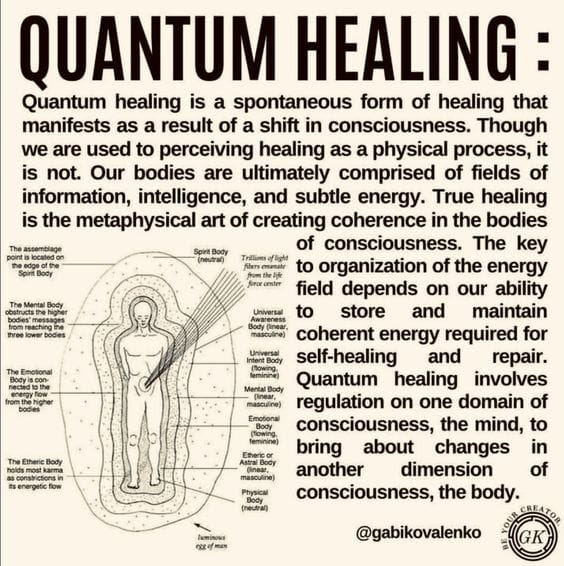
The term “quantum healing” often evokes a sense of mystery and possibility, suggesting a form of healing that goes beyond conventional physical approaches. The image you shared describes it as “a spontaneous form of healing that manifests as a result of a shift in consciousness.” This concept taps into the idea that our bodies are more than just physical matter; they are intricate fields of information, intelligence, and subtle energy. But what does this actually mean, and what does the scientific community say about it? Let’s explore the theories and perspectives surrounding quantum healing.

The Core Idea: Coherence in the Bodies of Consciousness

According to the image, true healing is presented as “the metaphysical art of creating coherence in the bodies of consciousness.” It suggests that the organization of our energy field is crucial for self-healing and repair. This framework posits that we are not simply physical beings but possess layers of interconnected “bodies,” as illustrated:

  • Physical Body: The tangible body we experience.
  • Etheric/Astral Body: Described as flowing and feminine, potentially related to our vitality and emotions.
  • Emotional Body: Associated with our feelings.
  • Mental Body (Linear, Masculine): Linked to our thoughts and linear processing.
  • Universal Mental Body (Flowing, Feminine): Perhaps connected to intuition and a broader understanding.
  • Spirit Body (Neutral): Seen as encompassing the other bodies, where the “assemblage point” is located.

The theory suggests that imbalances or incoherence in these subtle bodies can manifest as physical ailments. Quantum healing, therefore, aims to restore harmony and coherence at these deeper levels, leading to healing in the physical body. The image mentions that quantum healing involves “regulation on one domain of consciousness, the mind, to bring about changes in another dimension of consciousness, the body.”

The Role of Consciousness:

A central tenet of quantum healing is the power of consciousness. Proponents suggest that focused intention, visualization, and a shift in awareness can influence our body’s energy fields and trigger the self-healing process. This aligns with some research in the mind-body connection, such as the impact of stress on physical health and the potential benefits of mindfulness and meditation.

“Trillions of Light Fibers”: Information and Energy Transfer?

The image refers to “trillions of light fibers” that “emanate from the life force center.” This seems to suggest a network through which information or energy flows within these subtle bodies. While not directly recognized by conventional science, this concept resonates with ideas in some energy medicine modalities that propose the existence of biofields or subtle energy systems within the body.

Scientific Perspectives and Theories:

It’s important to note that quantum healing, as described in the image, is largely considered a pseudoscience by the mainstream scientific community. The existence of the “bodies of consciousness” and the mechanisms of energy transfer described are not supported by empirical evidence or established scientific principles.

However, the underlying idea of the mind-body connection is a well-researched area. Studies have shown that psychological factors like stress, emotions, and beliefs can significantly impact physical health. For example:

  • The Placebo Effect: This demonstrates the powerful influence of the mind on physical outcomes. Believing in a treatment can lead to real physiological changes, even if the treatment itself is inert.
  • Psychoneuroimmunology (PNI): This field explores the interactions between the nervous system, the immune system, and the mind, showing how psychological states can affect immune function and disease processes.
  • Mindfulness and Meditation: Research suggests these practices can reduce stress, improve immune function, and even alter brain structure and function.

While these fields acknowledge the profound impact of consciousness on health, they operate within a biological and neurological framework, rather than the metaphysical model presented in the image.

The Quantum Analogy:

The term “quantum” in “quantum healing” is often used loosely and does not typically refer to the principles of quantum physics in a direct or scientifically accurate way in this context. Quantum physics deals with the behavior of matter and energy at the atomic and subatomic levels, which operates under very different rules than the macroscopic biological systems of the human body.

In Conclusion:

Quantum healing, as depicted in the image, presents a fascinating perspective on healing that emphasizes the role of consciousness and subtle energy fields. While the specific mechanisms described are not currently supported by mainstream scientific evidence, the broader concept of the mind-body connection is a significant area of scientific inquiry. Understanding the interplay between our thoughts, emotions, and physical health is a valuable pursuit, even if the explanations differ.