
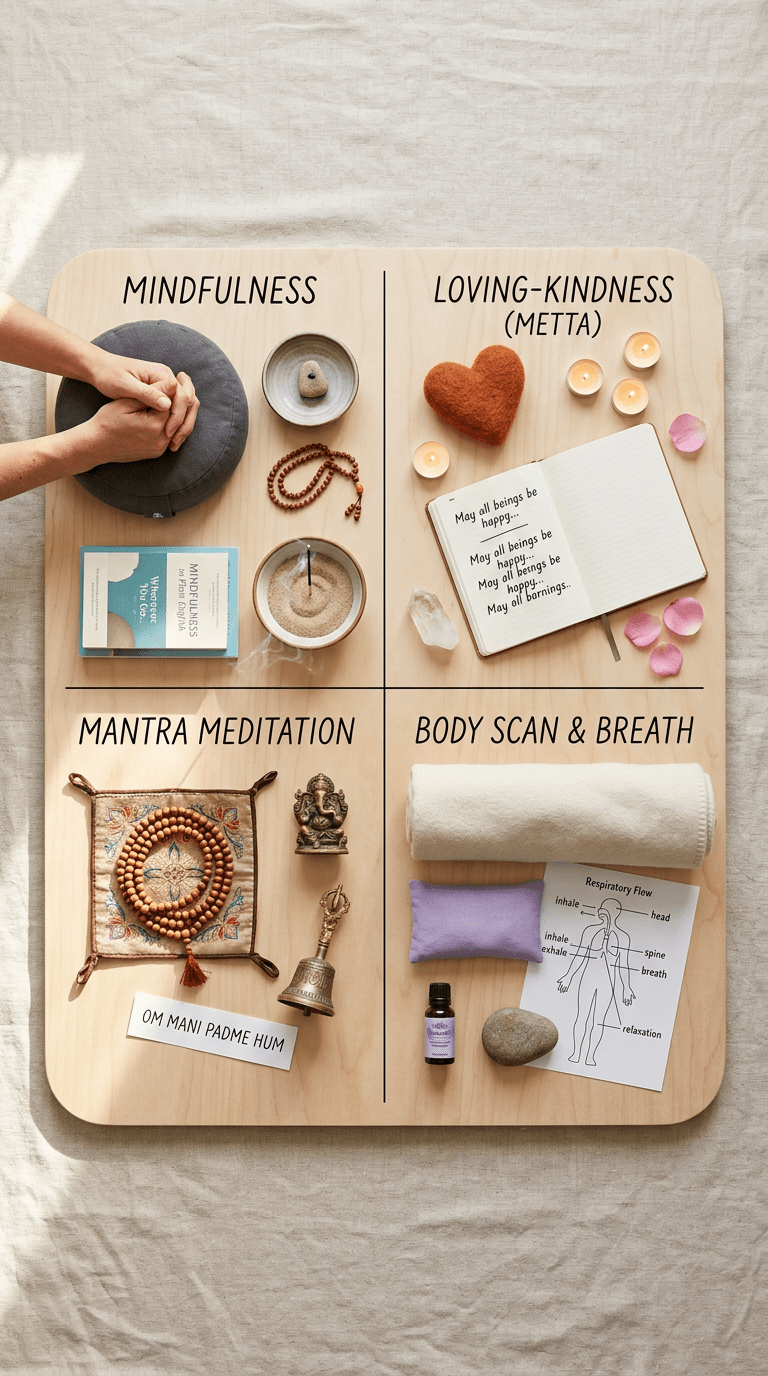
When you picture meditation, what do you see? Most likely, it’s someone sitting cross-legged on a floor cushion, eyes closed, looking impossibly serene in a perfectly quiet room.
If that image makes you feel restless instead of relaxed, you aren’t alone. For a lot of us, sitting completely still with a quiet mind feels less like inner peace and more like an uphill battle.
Here is the good news: meditation isn’t a one-size-fits-all deal. It is a vast collection of mental training tools. If the classic “sit and breathe” method doesn’t work for you, there are plenty of other ways to find your calm.
Let’s look at four distinct meditation styles—ranging from traditional stillness to active movement—so you can find the one that fits your unique rhythm.
1. Mindfulness Meditation: The Art of Noticing
Mindfulness is the foundation of most modern meditation practices. Instead of trying to “empty” your mind (which is nearly impossible), you focus on being fully present in the current moment without judging whatever pops into your head.

- How it works: You sit comfortably and anchor your attention to something sensory, usually the rise and fall of your breath. When a thought passes by—like Did I lock the back door? or I need to buy groceries—you simply acknowledge it and gently pull your focus back to your breath.
- Best for: Quieting a racing mind and managing daily stress.
2. Walking Meditation: Mindfulness in Motion
If sitting still makes you want to crawl out of your skin, moving meditation is your ticket. Walking meditation takes the exact same mental muscles used in sitting mindfulness and applies them to a slow, deliberate walk.
- How it works: Find a quiet path or even a long hallway. Walk at a slightly slower pace than usual. Instead of letting your mind wander to your to-do list, tune into the physical sensations of movement. Notice the heel-to-toe roll of your feet, the shifting weight in your legs, the feeling of the air on your skin, and the sounds around you.
- Best for: Anxious minds, high-energy individuals, or anyone who sits at a desk all day.
3. Loving-Kindness (Metta) Meditation: Cultivating Compassion
Sometimes we don’t just need to quiet our thoughts; we need to shift our emotional tone. Loving-Kindness meditation focuses on developing an attitude of love, empathy, and positive energy toward yourself and others.
- How it works: While sitting quietly, you silently repeat a series of wishes for well-being. You start with yourself, then expand outward. A traditional script goes like this:”May I be happy. May I be healthy. May I be safe. May I live with ease.”After directing this toward yourself, you mentally send the same wishes to a loved one, a neutral person, someone you are having conflict with, and eventually, all living beings.
- Best for: Boosting emotional resilience, softening self-criticism, and melting away anger or resentment.
4. Body Scan Meditation: Your Physical Reset
We carry an immense amount of stress in our bodies—clenched jaws, tight shoulders, shallow breathing—often without even realizing it. A body scan systematically checks in with your physical form to release that built-up tension.
- How it works: Usually practiced lying down, you mentally move your attention through your body, starting at your toes and working all the way up to the top of your head. You notice any areas of tightness, pain, or warmth, and consciously imagine breathing relaxation into those specific spots.
- Best for: Unwinding at the end of a long day, grounding yourself after an overwhelming event, or falling asleep.
Which One Should You Choose?
The best meditation style is simply the one you will actually do. Use this quick guide to pick your starting point:
| If you feel… | Try this style: | What it does: |
| Restless & Fidgety | Walking Meditation | Channels physical energy into focused presence. |
| Stressed & Overwhelmed | Mindfulness | Helps you step back from a chaotic cascade of thoughts. |
| Self-Critical or Angry | Loving-Kindness | Actively rewires your emotional habits toward empathy. |
| Physically Exhausted | Body Scan | Disconnects the brain’s stress response from the body. |
Meditation isn’t about achieving a flawless, thought-free state of zen on the first try. It’s just about picking a style that meets you exactly where you are today and taking five minutes to tune back in.
Here is a simple, straightforward framework to take your practice off the cushion and onto your feet. You don’t need any special gear, and you don’t need to hike out into nature—a quiet sidewalk, a backyard, or even a long hallway at home works perfectly.
Have you thought about becoming a mediation teacher? Check out Meditation University Here
Your 5-Minute Mindful Walk
1.Set your boundary and posture: Minute 1.
Choose a straight path where you can walk safely for about 10 to 15 paces without obstacles. Stand still for a moment. Feel the weight of your body pressing down through your feet. Roll your shoulders back, let your arms hang loosely at your sides (or clasp your hands gently in front of you), and keep your gaze soft, looking about 6 feet ahead on the ground rather than down at your toes.
2.Begin at half-speed: Minute 2.
Start walking at a pace that is slightly slower than your usual stride—no need for regular power-walking speed. As you take your first few steps, shift your entire focus to the bottom of your feet. Notice the mechanics of a single step: the heel striking the ground, the roll forward onto the ball of the foot, the lift, and the transition of weight to the other side.
3.Sync with your breath: Minute 3.
Let your steps find a natural rhythm with your breathing. You might notice that you take two steps for every inhale, and two steps for every exhale. Don’t force your breath to change; simply let your movement match your natural lung capacity. If your mind starts to drift back to your day, notice the thought, let it go, and bring your focus back to the physical sensation of the soles of your feet connecting with the earth.
4.Expand your awareness: Minute 4.
Gently widen your focus from just your feet to include your other physical senses. Notice the feeling of the air or wind against your face. Listen to the immediate sounds around you without pausing to analyze them—just let them pass through your awareness. Notice the shifting play of light and shadow as you move forward.
5.Pause and transition: Minute 5.
Bring your steps to a gradual halt. Stand still for the final 30 seconds. Take one deep, conscious breath all the way down into your belly, exhale fully, and check in with how your body feels before you resume your normal pace for the rest of the day.
Peer Note: If you find yourself overthinking your stride or feeling clumsy at first, that is completely normal. The goal isn’t to walk perfectly; it’s simply to notice how it feels to move.


