What does it mean to have a β€œpure soul” and the signs

The idea of having a pure soul can mean different things to different people.
For some, it just comes down to having a decent heart and being kind. Being caring, sympathetic, and warm towards others.
It may have a greater spiritual or religious significance to others. Being a pure soul is a concept that almost seems heavenly.
The essence of what makes us human is our soul. Behind all the masks we wear, it is who we really are.
This is what many consider to be the vital and immortal portion of ourselves that survives death.
Whilst life experiences may taint us or change us, this underlying part of us remains true.
Thus, when we discuss having a pure spirit, we are referring to a soul that has not yet been tarnished by life’s hardships.
As Mahatma Gandhi, a political activist, once declared:
β€˜The pure love of one soul can offset the hatred of millions.’
But what qualities define a pure soul?
Let’s examine this.
Signs that you have a pure soul
1) You have humility
You can build better and more robust relationships with other people by doing this. Additionally, it promotes honesty and openness.
It’s also crucial to our development because studies have even revealed that humility has a greater impact on success in life than IQ.
Even the most pure individuals in life manage to maintain their humility in the face of significant accomplishments.
Despite their enormous global influence, Mother Teresa, Gandhi, and Martin Luther King all possessed a selfless humility that kept them grounded.
2) You are a force for good
Rather than cultivating negativity, pure hearts foster positivity.
This is not to argue that they are unaffected by life’s challengesβ€”quite the contrary.
Simply said, they desire to be a positive influence on the world and understand that the only thing that can defeat darkness is light.
That entails emphasizing love above hatred. Rather than placing blame, they try to understand. To find compassion over condemnation.
Being a pure soul means that you actively look for the good in life β€” both in situations and in people.
Pure souls may have faced plenty of trials but they still prefer to approach things with a glass-half-full mentality.
3) You are giving
Generous spirits are pure.
Whether it’s their food on the table, their time, energy, or kindness, they are pleased to share with others what they have.
Giving is less about how much you have materially. Some of the most giving people on this planet have the least.
It is primarily about having the willingness to give to others. To help those who need it.
The paradox lies in the fact that generosity benefits everyone, not just the recipient.
Studies have indicated that it enhances our well-being and strengthens our social bonds.
Giving is also contagious. So-called β€œpaying it forward”, is where we receive an act of kindness and generosity and end up passing this on to others.
4) You are grateful
Pure-hearted people often appear to be the happiest and most pleased. And thankfulness is one of their key strategies for developing this.
One of the main components of happiness is gratitude. It helps us to see the beauty in everything around us.
We have discussed how pure souls are immune to the entanglement of daily existence. And materialism is one of those entanglements.
Rather than getting fixated on what we don’t haveβ€”which can lead to deep-rooted frustration and dissatisfaction β€” gratitude helps us to feel satisfied.

Ayurveda Recipes: Coconut, Raspberry & Peach Popsicle

Tart sweet, creamy and cool on a summer day, homemade popsicles are a treat for your kids, or the kid in you!
As the summer heats up, your nerves may feel sizzled as your patience wanes. Summer heat, especially when combined with dryness, truly does grate on the nervous system, making you feel impatient and testy. The myelin sheath, which surrounds each and every nerve, is made up of nerve calming fats. A string of hot days can make your nervous system threadbare, dry and desperate for nourishment. Coconut milk restores tranquility by offering nourishing insulation back to your nervous system through its wonderful content of healthy fat.
Ingredients
2 c COCONUT MILK
1 whole PEACHES
1 c RASPBERRY
Instructions
1. Coarsely chop the peach and raspberries. Place in a medium mixing bowl.
2. Mix in one 14 oz. can of coconut milk.
3. Pour mixture into popsicle molds and freeze for at least three hours or overnight. Have them ready to go for the next day!

How to Overcome Limiting Beliefs and Connect with Your True Nature

What is a limiting belief?
It should come as no surprise that a limiting mindset does exactly thatβ€”it restricts your perspective on the world and, consequently, your potential. These are the things you’ve grown to accept as true about society, yourself, or the way the world functions.
Those beliefs convince our minds that something that isn’t true (can’t be proven) is, indeed, a fact. These kinds of cognitive distortions feed negative beliefs, which, as Positive Psychology notes, grow stronger over time and have the capacity to drag you down into a pit of despair and anxiety. I for one wouldn’t choose to live a life filled with negativity and discontent, and I don’t think any of us do it on purpose. Having said that, when clouds of cognitive distortion begin to form, there are particular, evidence-based actions we may take.
Identify your limiting beliefs.
Since limiting beliefs are frequently subconscious, it could be challenging for you to identify them if they’re not visualizing them as a movie in your head. Here are some more examples of the kinds of thoughts that could indicate someone has restricting beliefs (some of which you may even recognize!):
I’m too old.It’s too late.I don’t know what I want.I’m too poor.I lack money and resources.I’m too fat or too skinny…too tall or too short.I’m not smart enough.I’m not popular enough.I’m not connected enough.I don’t have time for myself.There’s never enough time.Others are in my way.It’s never worked before.I can’t start now because I am not ready.I’m too dumb.Money doesn’t grow on trees.
Your limiting beliefs may not be based on reality.
One method to lace up your boots and be ready to fight those bad thoughts swimming around your subconscious is to sit with your thoughts. Since thinking leads to questioning, there are important questions we may ask to help reframe or filter what, let’s be honest, are occasionally absurd notions.
What are your feelings on a specific circumstance? Are you making assumptions about things you, yourself have not experienced? Can you guarantee that an action will always have the same result, even if you have had a bad experience as a result of it? Is what you believe to be true?
Question your way to a healthy mindset.
You can use this technique to examine the evidence for and against your belief:
1. Become aware. Ask yourself: what am I thinking?
2. Analyze patterns. Ask yourself: why do I think this way? Which narrative do I believe, or have I believed?
3. Confront your beliefs. Ask yourself: is this thought true? Where is the proof that this holds true every time?
If it isn’t always true, it isn’t a fact.
And last, what would my life look like if it was filled with hope and positivity? This question will help bring into focus what kind of person you want to becomeβ€”and why certain beliefs need to be changed so that can happen.

Teardrop Bow Pose (Padangustha dhanurasana)

What is Teardrop Bow Pose?
Teardrop bow pose, or padangustha dhanurasana in Sanskrit, is an advanced and amplified version of bow pose (dhanurasana). The hands grip the feet in a deep arch, improving spinal flexibility and awakening the mind.
Instructions
Begin lying on the belly in snake pose with the body weight supported on the forearms.Bend the right leg and bring the foot toward the buttocks. Inhale and grab the outside of the foot with the right hand. Rotate in the shoulder socket so that the elbow is pointing up. Do the same on the left side.Inhale and straighten the arms and legs, lifting the feet higher toward the sky.Breathe while holding the pose.Exhale and slowly release the feet one at a time.

Practice Emotional Self-Care

Emotional self-care: what is it?
Emotional self-care is, to put it simply and clearly, taking care of our feelings and emotions. It’s how we compassionately react to the states of our body and mind.
Let’s first clarify the distinction between feelings and emotions in order to do that. According to Psychology Today, “Emotions and feelings are two distinct but related phenomena, even though the terms are sometimes used interchangeably. Sensations in the body are the source of emotions. Though they originate from our concepts in the mind, feelings are impacted by our emotions.
Example: You notice the emotion of discomfort while at a party as your stomach clenches and your breathing gets constricted. Then your mind labels that as feeling awkward because perhaps you don’t know many people there, or you just saw an ex-boyfriend. However, someone else experiencing the same emotional body sensations can describe the encounter as exciting because they get to see their ex again or meet new people.
Ways to Practice Emotional Self-Care
1. Practice awareness
Being conscious of a problem is the first step towards addressing it or making it better. We become so engrossed in our ideas that we lose track of the feelings emanating from our bodies.
Carrying out a body scan is an excellent way to exercise awareness. I advise you to do this whenever you can, at least once a day.
Basically, a body scan is giving attention to each part of your body from top to down slowly and individually. From the top of your head to your toes.
2. Write your emotions and how you feel
I find that writing, especially writing about how I’m feeling, is a really fulfilling practice. It has through the years helped me understand how my emotions influence what I think and feel.
What you can do is write about how your day was at the end of every day and focus on any of the particular moments where you experienced stronger emotions and feelings. This can assist you in identifying trends, evaluating the motivations behind your reactions, and figuring out how you wish to handle similar circumstances going forward.
3. Connect to the moment
One of the great ways of being mindful is deep breathing. Simply existing in the present moment without passing judgment is mindfulness.
Breathe through your nose, roll your shoulders, and let your body relax. Try to notice the sensations in your body without trying to change them. Keep breathing and just observe and accept them for who they are.
Another way to connect to the moment is to surrender control and observe everything as it is. Don’t think about what you should or should not do, just observe. This is something you can do anyplace. Your breathing will naturally slow down as you relax and become more present in the moment.
4. Express your emotions to someone you trust
Oh, where would I be without my friends? I firmly, firmly know in my heart that when we share how we are with someone who listens and responds with empathy, our lives become so much easier.
My sincere pals have helped me get through some really tough days far faster and in better form than I could have on my own.
Please let the one person in your life who you feel comfortable confiding in to support you. You do not cause trouble. If they’re a good friend, they would be there for you just as you would be there for them.
5. Take the right steps for your emotions
There are people and situations that no matter what you do will never change and will keep hurting you whenever you interact with them.
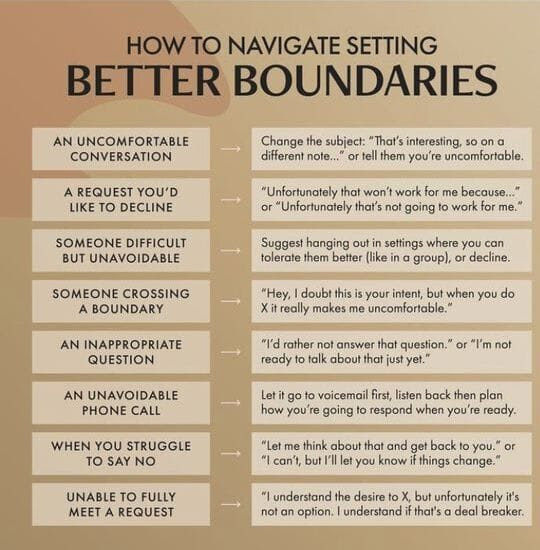
Choose to set boundaries to protect your heart.