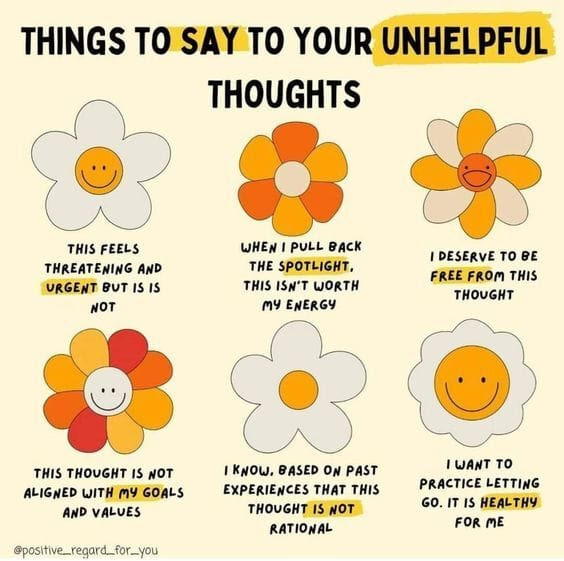
Reframing Negative Thoughts: Recognize, Reflect, Question, Replace

“Winning doesn’t always mean being first. Winning means you’re doing better than you’ve done before.”
Common negative thinking patterns can be grouped into four main categories.
Catastrophizing: This is when we expect the worst to happen. For example, if you make a small mistake at work, you might start thinking that you’ll get fired, even when there’s no real evidence for it.
Overgeneralization: This occurs when we take one negative event and believe that it’s going to keep happening. If you have a bad date, you might think, “I’ll never find someone who likes me,” which is unlikely.
Personalization: This is when you believe that everything others do or say is some kind of reaction to you. For instance, if a friend is short with you, you might think it’s because they’re mad at you, when they could just be having a bad day.
All-or-nothing thinking: In this pattern, things are either perfect or terrible, with no middle ground. For example, if you don’t meet all your goals, you might think you’re a complete failure, which is not a fair or realistic way to judge yourself.
How to reframe negative thoughts
1. Notice your negative thought
Recognize when a negative thought enters your head. It might concern someone else, yourself, or even a circumstance. The first step to altering these thoughts is acknowledging them.
Use an app on your phone or keep a little notebook for notes. Note down any bad idea that occurs to you. This exercise facilitates the identification of negative thought patterns and triggers.
2. Take a break and reflect
Breathe deeply and count to five whenever you catch yourself thinking something bad. This little diversion can help you reframe the idea and prevent it from spiraling out of control.
3. Question the thought’s accuracy
After jotting down the unfavorable thinking, question it by posing queries such as “Is this thought really true?” or “Do I have proof to back up this idea?” You’ll frequently discover that your pessimistic ideas are more grounded in emotions than in reality.
4. Seek alternative explanations
Examine alternative perspectives on the matter. Is there a more positive or neutral perspective you could take? For example, if you’re thinking, “I never do anything right,” you might reframe it to, “I make mistakes sometimes, but I also have many successes.”
5. Replace with a positive thought
For each negative thought you identify, try to think of a positive or more realistic counterpart. This calls for a more nuanced perspective on the issue rather than dismissing it entirely. When a buddy doesn’t respond to your text and you assume that “I must have offended them,” think of alternate scenarios. For example, “They might be busy or didn’t see my message.”

7 Ways to Strengthen Resilience and Improve Mental Health

“Wherever you go, no matter what the weather, always bring your own sunshine.”
Over time, resilience is a skill that can be improved and developed. Developing resilience is implementing techniques that improve your capacity to handle obstacles in life.
1. Nurture strong relationships
In relationships, you have a support system. Invest time and effort in building and maintaining good relationships with family, friends, and colleagues.
Make plans for a regular activity with a trusted person, such as going for a weekly stroll or coffee date.
2. Prioritize physical health
Your resilience is greatly impacted by your physical health. A healthy body can recover from illness or exhaustion more quickly and can handle stress better.
3. Discover your purpose
Having a purpose in life can help you stay motivated and on track, especially when things are difficult. It can be found in your job, hobbies, volunteering, or relationships.
4. Embrace change
Being able to accept and adjust to change might help you become more flexible and resilient. Name a recent shift that occurred in your life, and then write in your notebook about the possibilities and lessons it provided.
5. Build self-confidence
You can overcome obstacles more skillfully if you have faith in your talents. List your strengths, accomplishments, and learnings from failure to remind yourself of your capabilities.
6. Maintain perspective
Recognize your emotions in a particular scenario, but keep an eye on the wider picture to save yourself from becoming overwhelmed. When faced with a challenge, write down both positive and negative aspects to maintain a balanced view.
7. Develop problem-solving skills
Being able to solve difficulties gives you the confidence to take action, which strengthens resilience. Next time you face a problem, brainstorm possible solutions before deciding what to do.
8. Learn stress management techniques
During trying circumstances, it’s essential to manage stress well. Discover what relieves your stress the most for you by trying out several stress-relieving techniques, such as breathing techniques, yoga, therapy, walking, or journaling.

How to balance and show up for yourself


**The Seven Pillars of Self-Care: Find Your Balance!**

Does self-care ever feel like another thing on your to-do list? Maybe you desperately need self-care, but you’re never sure exactly how to make it happen?

There’s a lot of information out there about self-care, which usually only makes things more confusing when all you know is that you need to take care of yourself, but you’re not sure what that should look like.

That’s what we are here for – we are here to help guide you to finding what’s best in your specific journey: Look at self-care in terms of seven pillars. Seven might sound like a lot, but once you know them, you can better recognize what needs work in your life instead of trying to do everything and ending up doing nothing instead.

**The pillars of self-care:**

1. **Mental**: Cultivate a healthy mindset through mindfulness and curiosity.
2. **Emotional**: Take care of your heart with healthy coping strategies.
3. **Physical**: Care for your body with exercise, nutrition, and proper sleep.
4. **Environmental**: Take care of the spaces and places around you.
5. **Spiritual**: Engage in activities or practices that give a sense of meaning to your life.
6. **Recreational**: Make time for hobbies, fun activities, and new experiences.
7. **Social**: Build relationships with regular connection and healthy boundaries.

Seeing this list might feel overwhelming. You might think you have to find some kind of perfect balance between them all. You don’t need to focus on finding a perfect balance between them all, especially all at once. Focus on one area for a week, maybe even a month. When you’re ready, you can focus on adding in more as you go.

What’s most important is noticing which one (or two) areas need your attention most so that it doesn’t start dragging the other areas down along with it.

Taking care of you is so important for your health & wellness – make sure you are intentional about it even on the crazy & busy times because that’s when you probably are in need of it most!

Which ones resonate with you? Which ones listed above will you be practicing next?!

#SelfCare #Wellness #MentalHealth #EmotionalHealth #PhysicalHealth #EnvironmentalHealth #SpiritualHealth #RecreationalHealth #SocialHealth

Boost Your Self-Confidence: Stop Comparing Yourself to Others

“The most powerful relationship you will ever have is the relationship with yourself.”
Stop Comparing Yourself to Others
Although social media opens up a lot of good opportunities, it can also foster harmful ideas. Everyone has experienced the natural tendency of comparing their lives to what they see on social media at some point.
When you see that you are making comparisons, how do you gain confidence? First, tell yourself that it isn’t beneficial to do so. There is no competition in life; each person is competing in their own race.
Reminding yourself of your own accomplishments and talents is a fantastic place to start because it will help you concentrate on your own life rather than the lives of others.
Surround Yourself with Positive People
Perhaps more than you realize, the people you spend time with can affect the way you think about and feel about yourself. Thus, be aware of how other people make you feel. It could be time to say goodbye if, after spending time with a certain individual, you feel self-conscious.
While having a large social circle is not a terrible thing, it is also not incorrect to have a small one. Seek for people who can boost your confidence and are optimistic. Positivity and self-assurance go hand in hand.
Take Care of Your Body
We have talked about how you can show respect to yourself through taking care of yourself and this will also result in having more confidence. If you are mistreating your body, it is difficult to feel good about yourself. You’ll inherently feel more confident if you practice self-care since you’re taking good care of your mind, body, and spirit.
Face Your Fears
Try confronting some of your anxieties that are caused by a lack of trust in yourself. Try even if you’re worried you’ll look foolish or that you won’t do it well. A small amount of self-doubt may even boost output.
You may discover that occasional anxiety or a few slip-ups aren’t as terrible as you once believed. Additionally, as you advance, your self-confidence grows.

Effective Strategies for Cultivating Optimism and Gratitude

“The attitude of gratitude is the highest yoga.”
You must accept and welcome the fact that thinking positively is a purposeful and conscious decision in your life. Here are some really effective strategies on how to improve positive attitude –
1. Practice Gratitude
Adopt a grateful mindset. It is among the easiest and most effective strategies for cultivating optimism. Every day, take a few minutes to reflect on the blessings in your life.
It could be something as easy as making dinner at home, something important like completing your job ahead of schedule, or something enjoyable like going on a date.
The moment you shift your focus to the positives, your consciousness and attention is withdrawn from stressors, worries and negative thoughts. This contributes to making the room necessary for developing a growth attitude and optimism.
2. Surround Yourself with Positivity
The individuals in our immediate environment have a big impact on our feelings and thoughts. Your heart and mind will be overflowing with negativity if you spend a lot of time with people who constantly complain and whine or who have a scarcity mindset.
It is for this reason that you should associate with and be surrounded by people who inspire you. People that radiate positivity and encourage others. Being in their presence will help you comprehend their outlook on life.
Another helpful strategy is to avoid or restrict your access to news, social media and toxic environments that can leave you feeling drained and lead to negative thinking. Instead, take part in things that make you joyful and raise your spirits.
3. Practice Mindfulness
Living in the present allows you to be more hopeful and more capable of overcoming intrusive negative thoughts. You can deliberately choose to have a happy attitude in life by being attentive of the present moment and objectively observing your thoughts and feelings.
Additionally, practicing mindfulness can increase your awareness of your thoughts and emotions and make you feel calmer and more at ease in daily life. Controlling intrusive thoughts and increasing your optimism can be achieved by reducing stress and improving awareness. This is the daily approach to positivity.
4. Reframe Negative Thoughts
It’s normal to experience negative thoughts when we deal with dangers and difficulties on a regular basis. No one is 100% optimistic all the time. However, you can reframe this pessimistic mindset by changing your inner thoughts and rephrasing them to more empowering and positive thoughts.
When presented with a problem, for instance, concentrate on the lessons you can take away from it rather than the chances you lost. Pay more attention to the opportunity for development than to the obstacle or setback. No, it won’t be simple, but with little practice, you may improve your attitude and way of thinking.