Discover Your Rising Sign and Influence

“To be beautiful means to be yourself. You don’t need to be accepted by others. You need to accept yourself.”
What is a rising sign?
The planetary influence that was rising at the time of your birth—that is, on the Eastern horizon—is represented by your rising sign. It’s about first impressions. It usually conveys how other people perceive you in real life and can also forecast your spontaneous, instinctive responses to situations. Your rising sign is the part of you that is most visible to others; your outward facade / social version.
Is my ascendant sign the same as this?
Because of its connection to the rising sun, your rising sign is also referred to as your ascendant sign, and birth chart analysis frequently describes it this way. It is the same thing, so don’t be confused (just as sun and star signs are actually the same thing).
Why is knowing my rising sign important?
Well, aren’t you curious about how you come across to other people? A lot of people consider your rising sign to be your outgoing nature and the side of you that other people first notice. Weirdly, if someone is guessing your sign, they might hit upon your rising sign before your sun sign. Put it to the test!
How does it influence me?
Your rising sign is a reflection of your physical characteristics, personality, and social persona, since it indicates which sign was in the sky when you were born. This is a part of yourself that you are not familiar with (maybe what we see when we watch ourselves on camera), and as such, it may be both fascinating and a little embarrassing. If your sun (or star) sign is your fundamental personality type and your moon sign your inner emotional, mushy core, then your rising sign reveals the façade you present to the world.
How do I work out my rising sign?
Provided that you have your date of birth, time, location, and birth, several free websites will calculate it for you.

Discover the Digestive Benefits of Peacock Pose

What is Peacock Pose?
Peacock pose, or mayurasana in Sanskrit, boosts the digestive fire perhaps more so than any other yoga pose. In this advanced posture, the practitioner balances on their forearms with their elbows pressing against their abdomen.
Instructions
Begin kneeling. Place the hands on the floor, fingers pointing toward the body.Bend the elbows and lower the torso so that the chest rests on the upper arms.Stretch the legs back.Exhale and lift the legs from the floor. At the same time lean the torso forward. The body should be in one line and parallel to the floor.Breathe while balancing in the pose.Exhale and lower the legs to the floor to release.

4 Different Types of Energy Work

“If you see someone without a smile today, give ‘em yours.”
#1 – Reiki
Reiki is a Japanese style of bodywork founded by Mikao Usai. The term means “spiritually guided life force energy” when translated. It is an intervention in spiritual and vibrational healing that does not require physical manipulation. Reiki is a spiritual but nonreligious practice whose goal is to preserve physiological equilibrium by means of a faint vibrational field.
Reiki has been used to treat ailments alone or as a supplemental treatment to promote recovery and enhance the quality of life. The effectiveness of Reiki intervention and polarity therapy in reducing cancer-related fatigue has been demonstrated in clinical trials.
A modest, qualitative study revealed the beneficial impact of spiritual healing on long-term therapy-treated breast cancer patients’ experiences of survivability.
#2 – Polarity Therapy
Randolph Stone, an osteopathic physician, developed this technique in 1947. Polarity Therapy is a holistic wellness practice used in alternative medicine. The goal, which is influenced by both Traditional Chinese Medicine and Ayurveda, is to prevent or treat health problems by redistributing energy throughout the body using a combination of bodywork, exercise, nutrition, and counseling.
In 2019, a small study with middle-aged women looked at how four sessions of polarity therapy affected the participants’ symptoms of insomnia and anxiety. The ladies who received the treatment showed a clear improvement over the women in the control group, according to the results.”
“More research is needed to determine the overall effectiveness of polarity therapy to manage mental health or overall health challenges.” – Psychcentral.com‘s Polarity Therapy: Principles, Sessions, and Effectiveness
#3 – Ayurveda
‘Ayur’ means life and’veda’ means knowledge in Sanskrit, so the term ‘Ayurveda’ means knowledge of life. This natural medicine practice originated in India over 3,000 years ago and is based on the idea that diseases are a result of an imbalance within one’s consciousness. Ayurvedic medicine is considered on par with Western medicine in India.
An internal cleansing procedure is the first step in an Ayurvedic treatment plan. Other treatments include herbal remedies, massage therapy, yoga, meditation, and a particular diet. The primary concepts of the practice are universal interconnectedness, the body’s natural constitution (prakriti), and life forces (doshas). In Ayurvedic medicine, herbs, botanicals, oils, and spices are frequently utilized.
#4 – Craniosacral Therapy
Craniosacral therapy, or CST, is a kind of bodywork that uses light pressure to release tightness in the sacrum, head, and spine bones. Normalizing the flow of cerebrospinal fluid inside the central nervous system is the aim in order to assist the body’s inherent healing capacities and eliminate obstructions.
Common conditions for which CST is utilized include:
-migraines and headaches
-scoliosis
-fibromyalgia
-difficult pregnancies
-mood disorders
-and several others
Sessions are conducted in clothing and run roughly an hour. The practitioner may begin in the middle of the body, at the head, or at the feet. Many people have reported experiencing profound relaxation.

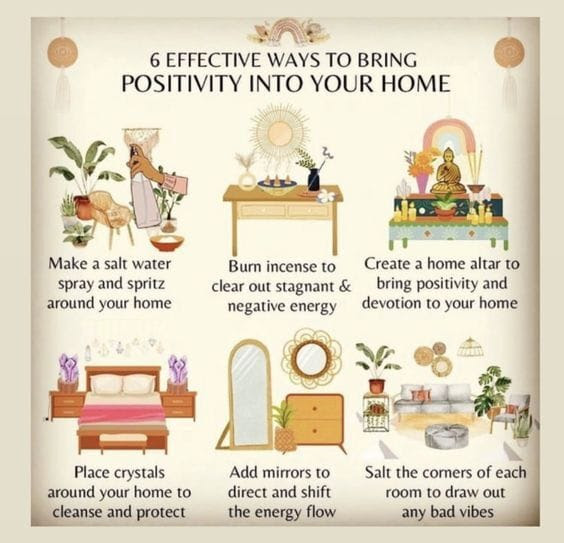
Build Positive Energy In Your Home

“Success is peace of mind, which is a direct result of self-satisfaction in knowing you made the effort to become the best of which you are capable.”
1. De-clutter your home:
 Follow the principle of minimalism! Get rid of nearly anything that is barely useful or nonexistent. You can decide that by eradicating everything that has never been used in the past 4-5 years, as those items have a very bleak chance of being used in the near future. You’ll be surprised to learn that clearing up clutter in your home brings positive energy into your space and makes you feel content and at ease!
2. Natural sunlight and fresh air: 
Gift your abode with natural sunlight and fresh air that will cost you nothing, but add a lot of positive energy and good vibes to your home! Nothing artificially lavish lighting can accomplish that natural light can. During the day, open the curtains and blinds and observe how a well-lit home makes you feel pleased and at ease!
3. Dreamcatchers and windchimes:
Dreamcatchers and windchimes are well renowned for their ability to draw happiness and calm into a home. They bring a restful sleep and a positive energy into our life by warding off negativity and evil eyes. Additionally, one can get dreamcatchers and windchimes that are so attractive that they double as décor for homes.
4. Idols:
Bring happiness into your home and surround yourself with idols that you believe in. For instance, you can go for a Laughing Buddha, Buddha in meditation, or a Ganesha, anything based on your beliefs, and place it in the foyer area of your house. Allow a happy energy to fill the house as soon as you walk in, and that of your guests.
5. Planters:
Natural healers, plants bring calm and fresh air into your home. In addition to cleaning the air, indoor and outdoor planters also help to clear our minds! Opt for the best-known positive energy home décor items, such as jade, spider plants, snake plants, aloe vera, tulsi, and ferns!
6. Wall art:
You might be surprised to learn that wall art plays a big part in bringing more positive energy into your house. Never hang disturbing or confusing paintings such as a ship stuck in a storm, war, still water, a crying, or a sad human. Choose anything that inspires you, such as koi fish, Buddha, lotuses, peacocks, Krishna, mountains, flowing rivers, seven running horses, flora and fauna, or any other natural setting!
7. Photographs capturing happy moments:
Making a collage or a spectrum of large and tiny photo frames that represent the happiest times spent with family and friends is another concept for a good energy home décor piece. Use your greatest photos and fashionable photo frames to make an eye-catching wall art, or display them on a side table or coffee table.
8. Aromatic candles:
In addition to being wonderful décor pieces, aromatic candles can ease tension and anxiety, promote calm sleep, mental clarity, and relaxation. The finest ways to create positive energy at home are with aromatic candles!
 

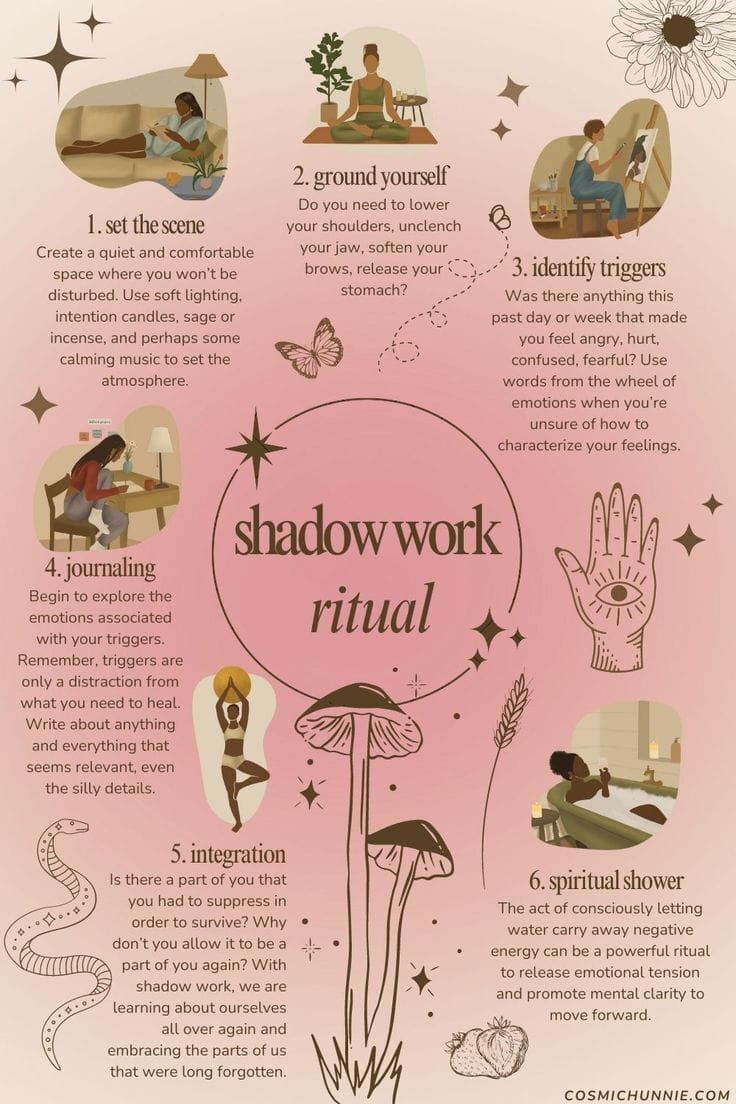
Shadow Work: Emotional Reaction Observation

“What you pour out into the world is poured right back into you.”
Exercise 1: Watch Your Emotional Reactions
Remember that the shadow is elusive; it hides behind us. The purpose of our defense systems is to suppress and hide the shadow archetype.
You will become more adept at identifying your shadow the more you observe your emotional responses. Recall that we frequently project our disowned aspects onto other individuals.
Observing how you feel about other people is one of the best methods to perform shadow work.
Sure, your colleague might be aggressive, arrogant, inconsiderate, or impatient, but if you don’t have those same qualities within you, you won’t have a strong reaction to their behavior.
Exercise 2: Engage in Inner Dialogue
A lot of inner work involves having an active conversation with your shadow.
Given that many people think “only crazy people talk to themselves,” this may initially seem unusual. However, each of us possesses multiple subpersonalities, or separate, independent aspects of our minds. These subpersonalities were dubbed archetypes by Jung.
Many different integrated psychologies offer ways of working with these disparate parts, including:
Jung’s Active Imagination
Schwartz’s Internal Family Systems
Stone and Winkleman’s Voice Di alogue
Assagioli’s Psychosynthesis
When we don’t pay attention to these parts—one or many aspects of our shadow—they influence our attitudes and behaviors.
Exercise 3: Challenge the Good Part/Bad Part
A lot of us consider ourselves to be “good people.” Being called a “good boy” or “good girl” when we were little caused us to identify with that praise. The division between the shadow archetype and our conscious self-identity grew as a result.
The instant you tell yourself, “I’m a good person,” your mind will begin to filter out everything you say, do, or think that doesn’t align with this belief.
Therefore, those who consider themselves to be “good people” almost often bring great suffering to both themselves and other people. Even worse, they are completely unaware of it! (That is, they are cut off from their true thoughts, feelings, and behaviors hidden in their unconscious.)
It also works the other way around: Your mind will likely ignore a lot of your excellent traits if you believe that you are a “bad person.” This is sometimes called the “golden shadow.”
Enumerate all the good things you have to offer. Then, highlight the opposite. Make an effort to recognize the opposite in yourself. For example, if you define yourself as disciplined, you’re likely repressing your laziness. Hiding in the shadows is the lazy side of me.
Your conduct and mindset are influenced by the pieces you have disowned. They incite internal conflict all the time. So, in this case, try identifying with this lazy part. See it. Accept it. Make friends with it. It’s okay to be lazy too.
Ego confrontations of this kind are essential to shadow work.