Ayurveda Recipes: Refreshing Lemongrass Carrot Soup

The fragrant essential oils of lemongrass will fill your kitchen with the scent of Asian cooking as you prepare this ‘Lemongrass Carrot Soup’. Put some relaxing music on and allow the aromatic nature of this meal calm the mind as you unwind. The vibrant orange of carrot and delicate cilantro greens will brighten up your evening meal.
If you tend to feel stressed out, irritable or experience skin inflammation (particularly in the summer months), you may have too much internal heat. This meal packs an anti-inflammatory punch that will pacify Pitta and cleanse overheated, toxic blood leaving you feeling cool, calm and collected.
Ingredients
4 whole CARROT
16 g CILANTRO
3 c COCONUT MILK
2 tbsp GHEE
1/2 inch GINGER (FRESH)
1 tbsp LEMONGRASS
1 tbsp MAPLE SYRUP
1 tsp TURMERIC
1 c VEGETABLE STOCK
Instructions
1. In a large pot, heat ghee on medium.
2. Add diced onion and gently fry for about 5 minutes or until translucent.
3. Remove tough outer skin of the lemongrass and pound with a rolling pin (to release essential oils).
4. Add to pot along with ginger, turmeric and chopped carrots and continue to sautee for 5-10 minutes.
5. Add coconut milk and vegetable stock and simmer for 20 minutes until carrots are tender.
6. Remove lemongrass, stir in maple syrup, and blend to a smooth consistency.
7. Garnish with chopped cilantro leaves.

Understanding Self-Acceptance: Benefits and Importance

“You will enrich your life immeasurably if you approach it with a sense of wonder and discovery, and always challenge yourself to try new things.”

Most people agree that accepting oneself is crucial to mental wellness. We’re all imperfect, so being harsh with ourselves about every shortcoming typically isn’t helpful or sustainable. Actually, studies have shown that persistent self-criticism can have a detrimental effect on welfare and self-esteem. While it can be a difficult concept to fully embrace for some, it’s a worthwhile pursuit because of the benefits it can bring.
Self-acceptance: what is it?
“A relatively objective sense or recognition of one’s abilities and achievements, together with acknowledgment and acceptance of one’s limitations,” is how the American Psychological Association (APA) defines self-acceptance. It’s about acknowledging that everyone has both good qualities, flaws, successes, and failures in life, and realizing that it’s unfair to hold ourselves to an impossible standard.
Self-esteem versus self-acceptance
It is important to understand that self-acceptance and self-esteem are not the same. Self-esteem is about positively judging yourself and your abilities, often in comparison to others. Contrarily, self-acceptance is the act of embracing who you are. While self-esteem is subject to swings depending on outside factors and life events, self-acceptance is more fundamental and stable throughout time.
What makes self-acceptance difficult?
Many of us find it difficult to accept who we are because society encourages us to assign values to everything from an early age, including ourselves. Many of us are raised in a culture that encourages continual comparison, which can lead to inflated expectations, self-criticism, and feelings of inferiority. Self-talk that is negative is very widespread, even in early childhood.
The benefits of self-acceptance: 
Again, self-acceptance can provide a more stable view of oneself compared to self-esteem, which is inherently comparison-based and can fluctuate. This could be the reason for the positive effects of self-acceptance on mental health that have been observed in research. One study found a correlation between “unconditional self-acceptance” and mood after exposure to negative events, and an inverse correlation with anxiety symptoms and narcissism.
Another study even found that self-acceptance decreased mortality risk by 19% and added three years of life, even when other factors were controlled for. A feeling of self-acceptance can help you achieve realistic goals, stabilize your relationships with others and yourself, manage mental illness, and generally feel better about yourself on a daily basis.

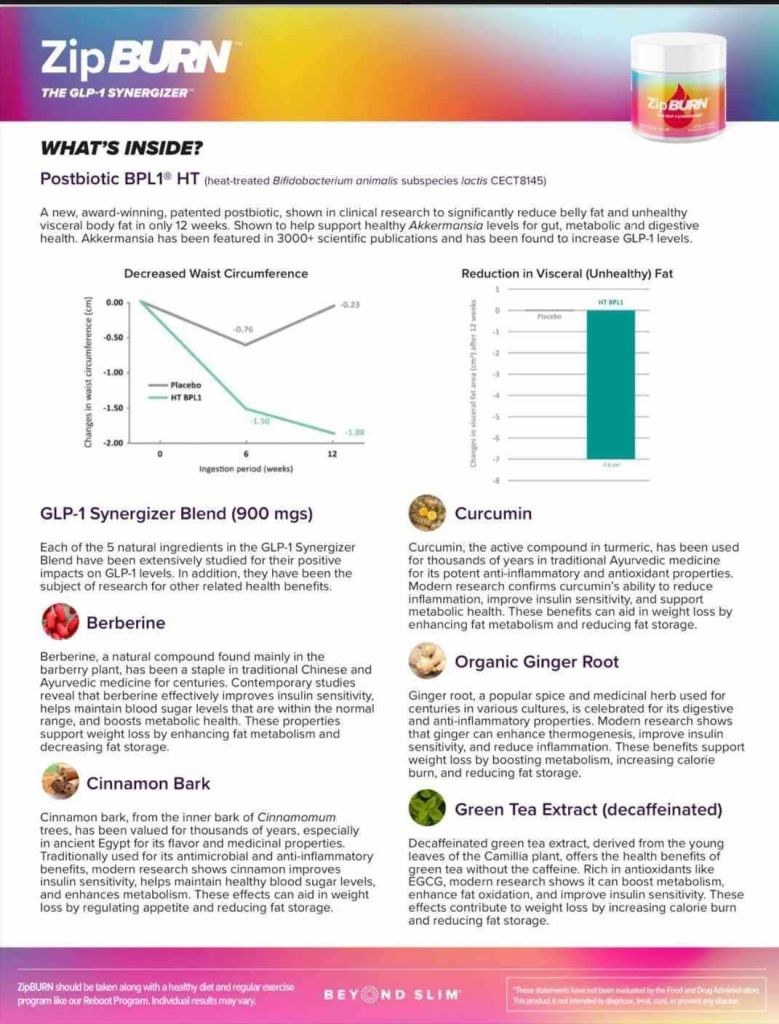
ZipBurn by Beyond Slim

(Please note there are links to discounted carts at the bottom.)

A GLP (Glycemic Load Plus) product is designed to support balanced blood sugar levels and overall metabolic health. Here are some benefits and a brief description:

Benefits:

Supports Healthy GLP-1 production*
Scientifically validated to target stubbom abdominal fat*
Helps fight unhealthy visceral body fat*
Helps maintain a healthy weight*
6 Helps support the body’s own healthy levels of Akkermansia, an important probiotic for gut, metabolic and digestive health*

ZipBURN™ is a proprietary, cutting-edge supplement that contains 5 key natural herbal ingredients that have been scientifically shown to naturally Increase GLP-1 levels, along with a new, patented bioactive postbiotic that fights abdominal fat and unhealthy visceral fat. ZipBURN™ has been specifically designed to provide optimal weight management support and help you get fitter, healthier and happier!

CARTS:

Mindful Shower Practice for Refreshing Moments and Renewal

“The only ones among you who will be really happy are those who will have sought and found how to serve.”

Showers can be incredibly refreshing or rushed and stressful, depending on where our minds are when we get in. I know there are times when my mind is so focused on the million things I need to do when I get out, I come out with one shaved leg. You know those moments where you can’t remember whether or not you rinsed the conditioner out of your hair? It’s because your mind was anywhere except in that shower with you.
The key to the mindful shower (and a lot of mindfulness practices) is not to try to clear your mind, but to try to focus it deliberately on your surroundings. As you get in, take a moment to turn your shower to the perfect temperature. Notice the temperature shift in your bathroom as the shower heats the air. Notice the way the water feels when it first touches your skin—is it warm? Too hot? Do you get goosebumps?
Really focus your mind on the sensations happening as you get clean. Appreciate the smells that arise from your soap, shampoo, and conditioner. If you shave or brush your teeth, focus in on those sensations as well. The sharp razor sliding across your skin, and the bristly tooth brush scrubbing away your morning (or evening) breath.
As you tune in to the great sensory experiences happening, think about what they mean to you. Getting clean can be a refreshing, renewing experience. Think of the old that you are gently scrubbing off, and the opportunities it gives you for the day ahead. If your thoughts wander to the many things you have to do that day, that is completely normal and expected. In the spirit of mindfulness, be kind to yourself. “Thank you, brain, for that reminder! I’ll get to it shortly.” And then tune back to your senses; the feeling of the water, the smell of the soap. See if you can slow time down and feel each drop of water as it hits your back.
Notice the pressure you’re applying to yourself as you get clean. Do you scrub your scalp like it’s caked with layers of mud and dirt? That probably isn’t necessary. Be gentle with your body, and pay attention to the habitual ways in which you treat it.
This shower doesn’t have to take any longer than your normal shower would. It could take four minutes or twenty—whatever feels right for you. Focusing your mind on what you’re doing in that moment will make you feel more refreshed than stressing over what you need to do when you get out, or what you should have said to that person last night. Give your mind that break so that you can handle more when you get out!
 

Start Your Day Right: Morning Bed-Making Routine

“The best way to cheer yourself up is to try to cheer somebody else up.”

1. Make your bed: 1 minute
Every morning make your bed to your own satisfaction, the white duvet perfectly aligned and pillows nicely plumped in my case. Eliminate any clutter from your bedroom to create a peaceful retreat. Having accomplished and managed something as soon as you get up sets the stage for you to maintain control over the course of the day.
2. Block one nostril: 10 seconds
We breathe quickly and shallowly when we are nervous. Our speeding minds have to settle down as we breathe more slowly. Closing one nostril with a fingertip can be helpful; this causes us to breathe half as quickly as usual, much like when we have a cold. You can only breathe in the present, so it’s the best way to be calm and centred. Think about anxiety – you worry about the future, you regret the past. Breathing keeps us in the present.
3. Be kind and practice a random act of kindness, preferably to a stranger: 1 minute
There is a very real correlation between kindness and happiness. We become kinder to ourselves and develop a more compassionate, accepting inner voice, which you can call upon to help you counteract negative thinking. Concepts consist of:
Pay a coffee forward
Smile
Say hi to the doorman, waiter, ticket collector, store worker, and barista.
Say “thank you” for being patient when you are running late instead of “I’m sorry.”
When someone speaks with you, listen carefully to what they have to say. Listen not to respond, but to understand. We have one mouth and two ears for a reason.
4. Wash your hands in a new way: 1 minute
You can focus attention on what we are experiencing in the moment by practicing mindfulness, which is a non-judgmental method. The hardest thing for me to do has been to integrate this into my daily life. The solution has been to incorporate mindfulness into a routine activity: I use hand washing. I pay particular attention to the sensation of cold water, the sound of the tap, the smell of the soap. These mindful moments provide full stops amid the rush, and a reminder to slow down.
5. Use the word ‘yet’: 1 second
Keep an eye on your language and consider how you could phrase any claims about your own helplessness. Language alone has the ability to empower others and increase our sense of victimization. So instead of saying, ‘I can’t deal with this,’ say ‘I can’t deal with this, yet.’
6. Learn this poem
We appreciate good times more by having experienced the bad. In fact, we would not appreciate sunnier times without living through the rainy ones. I adore how Scottish author Charles Mackay, who lived in the 19th century, conveys this idea in this poem. Every time life becomes tough, memorize and repeat this.
Oh, you tears,
I’m thankful that you run,
Though you trickle in the darkness,
You shall glitter in the sun
The rainbow could not shine if the rain
refused to fall,
And the eyes that cannot weep are the
saddest eyes of all.
7. Adopt an appreciation pause: 3 seconds
This is about appreciating those you wouldn’t routinely thank or notice in the busy rush to get things done. It could be the person at the till who serves you lunch, the office cleaner, the teacher who helped you solve a problem after class, a doctor who worked out why you haven’t been feeling well or the police officer patrolling your neighbourhood.
Just take a moment to consider all the people in your life who, while they are undoubtedly just going about their daily business, you may have forgotten about or taken for granted.
Think about how our lives would unravel without these people who take care of our environment, communities, education, and health. Maybe you will remember to thank them in the future. Although taking an appreciation pause is intended to help you pay attention to those you don’t know well, it also benefits close friends, family, and long-term partners—people we frequently forget about! Take one last moment to consider them as well, and silently thank them in your mind.