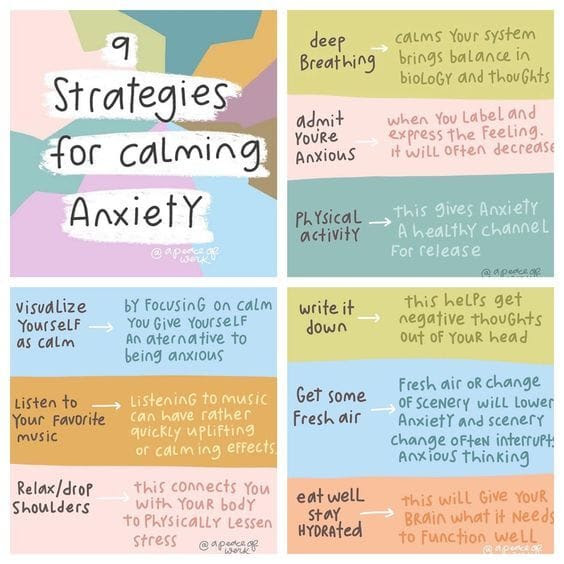
Practice Emotional Self-Care

Emotional self-care: what is it?
Emotional self-care is, to put it simply and clearly, taking care of our feelings and emotions. It’s how we compassionately react to the states of our body and mind.
Let’s first clarify the distinction between feelings and emotions in order to do that. According to Psychology Today, “Emotions and feelings are two distinct but related phenomena, even though the terms are sometimes used interchangeably. Sensations in the body are the source of emotions. Though they originate from our concepts in the mind, feelings are impacted by our emotions.
Example: You notice the emotion of discomfort while at a party as your stomach clenches and your breathing gets constricted. Then your mind labels that as feeling awkward because perhaps you don’t know many people there, or you just saw an ex-boyfriend. However, someone else experiencing the same emotional body sensations can describe the encounter as exciting because they get to see their ex again or meet new people.
Ways to Practice Emotional Self-Care
1. Practice awareness
Being conscious of a problem is the first step towards addressing it or making it better. We become so engrossed in our ideas that we lose track of the feelings emanating from our bodies.
Carrying out a body scan is an excellent way to exercise awareness. I advise you to do this whenever you can, at least once a day.
Basically, a body scan is giving attention to each part of your body from top to down slowly and individually. From the top of your head to your toes.
2. Write your emotions and how you feel
I find that writing, especially writing about how I’m feeling, is a really fulfilling practice. It has through the years helped me understand how my emotions influence what I think and feel.
What you can do is write about how your day was at the end of every day and focus on any of the particular moments where you experienced stronger emotions and feelings. This can assist you in identifying trends, evaluating the motivations behind your reactions, and figuring out how you wish to handle similar circumstances going forward.
3. Connect to the moment
One of the great ways of being mindful is deep breathing. Simply existing in the present moment without passing judgment is mindfulness.
Breathe through your nose, roll your shoulders, and let your body relax. Try to notice the sensations in your body without trying to change them. Keep breathing and just observe and accept them for who they are.
Another way to connect to the moment is to surrender control and observe everything as it is. Don’t think about what you should or should not do, just observe. This is something you can do anyplace. Your breathing will naturally slow down as you relax and become more present in the moment.
4. Express your emotions to someone you trust
Oh, where would I be without my friends? I firmly, firmly know in my heart that when we share how we are with someone who listens and responds with empathy, our lives become so much easier.
My sincere pals have helped me get through some really tough days far faster and in better form than I could have on my own.
Please let the one person in your life who you feel comfortable confiding in to support you. You do not cause trouble. If they’re a good friend, they would be there for you just as you would be there for them.
5. Take the right steps for your emotions
There are people and situations that no matter what you do will never change and will keep hurting you whenever you interact with them.
Choose to set boundaries to protect your heart.
 

Teaching the Ultimate

In early times in Japan, bamboo-and-paper lanterns were used with candles inside. A blind man, visiting a friend one night, was offered a lantern to carry home with him.
“I do not need a lantern,” he said. “Darkness or light is all the same to me.”
“I know you do not need a lantern to find your way,” his friend replied, “but if you don’t have one, someone else may run into you. So you must take it.”
The blind man started off with the lantern and before he had walked very far someone ran squarely into him. “Look out where you are going!” he exclaimed to the stranger. “Can’t you see this lantern?”
“Your candle has burned out, brother,” replied the stranger.

Healing From Past & Toxic Relationships

Journaling about relationships isn’t a magic solution to relationship problems, but writing about your relationships can help you enjoy deeper, more meaningful connections. Keeping a journal allows you to reflect on your feelings, actions, and reactions in a safe space. By putting pen to paper, you give yourself the opportunity to understand patterns, recognize areas that need growth, and appreciate the moments that bring joy.
Whether they be romantic, familial, or platonic, healthy relationships are typically characterized by several key components:
Trust: Trust is foundational in any relationship. It involves believing that the other person will act with integrity, honesty, and in your best interest. Breaches in trust, like dishonesty or betrayal, can be damaging, though not irreparable with effort and commitment.
Communication: Open, honest, and effective communication is essential. This means both speaking and listening actively, expressing needs, understanding, and seeking to be understood.
Respect: Treating each other with respect involves valuing and acknowledging each other’s feelings, wishes, and rights. It also means avoiding actions or words that are harmful or demeaning.
Boundaries: Healthy relationships have established boundaries that respect individual rights and feelings. These boundaries ensure that each person feels safe and valued.
Equality: Each person has equal say and equally invests in the relationship. Decisions are made together, and each person’s input is valued.
Independence: While sharing time and experiences is crucial, it’s also important for each person to maintain their sense of self and independence outside the relationship.
Empathy: The ability to understand and share the feelings of another person is crucial. It involves being attuned to each other’s emotions and offering support when needed.
Affection: Physical and emotional expressions of love, care, and appreciation, like hugging, complimenting, or saying “I love you,” can strengthen bonds.
Conflict Resolution: Disagreements and conflicts are natural in any relationship. However, the key lies in addressing them constructively, without resorting to blame, avoidance, or aggression.
Shared Experiences and Interests: While it’s essential to have individual interests, shared experiences and common interests can strengthen the bond between people.
Support: A healthy relationship involves mutual support in both good and challenging times. This means being there for each other, offering help, encouragement, and understanding.
Growth and Adaptation: As individuals change and grow, the relationship must adapt. Recognizing, appreciating, and accommodating for personal growth and changes ensures the relationship remains healthy.
Intimacy: For romantic relationships, emotional and sometimes physical intimacy is an important component. This intimacy is built on trust, respect, and open communication.
Commitment: Being dedicated to the relationship and working towards its longevity and health is crucial.
Journaling Prompts for Relationships:
What does a healthy relationship look like to you?
What does a toxic relationship look like to you?
Describe what romance means to you.
What are you most grateful for about your relationship?
How do you communicate love to your partner?
How do you want love communicated to you?
Is it easy or difficult for you to ask for help when needed? Why?
Do you believe in soulmates?
Do you believe in love at first sight?
In what ways could your relationship be better?
What are some ways you could make your partner feel more loved?
List 15 things you can do to make your relationship more fun (they can be realistic or far-fetched, anything goes!)
What are some ways to say “I love you” without using words?
Describe what commitment means to you.
Describe the moment when you first realized you were in love with your partner.

The 6 steps to mastering “negative” emotions…

The 6 steps to mastering “negative” emotions…
The truth is, there are no “negative” emotions because they all serve a purpose. Consider them as signals of action that provide insightful information and give us the ability to make a change. Yes, some emotions are tough, challenging us at our core. But growth requires that we recognize their signals.
To truly master your emotions, follow these 6 steps of emotional mastery:
Step 1: Identify the emotion
The first step is always to identify the negative emotion – or more accurately – the action signal. What kind of feeling is it? annoyance? Sadness? Or are you just hungry? Which feeling do you actually feel? Finding the central feeling will enable you to understand its important lesson.
Step 2: Appreciate & clarify the message
As soon as the emotion has been recognized, give it your whole attention and explain what it is trying to tell you. It basically tells you that something needs to change. Is it necessary for you to modify your behavior, such as your communication style? Or maybe by shifting your perception (i.e., the meaning) of a situation? Use the table in the next section to help clarify both the emotion and its powerful message.
Step 3: Get CURIOUS
Get curious about how you want to feel by asking these four questions:
How do you want to feel?
What would you need to believe to feel that way right now?
What are you willing to do to feel that way now?
What’s great about this situation or what can you learn from it?
Understanding the cause of an issue will help you keep it from happening in the future and realize that every issue is a gift.
Step 4: Get CONFIDENT from past success
Consider a specific instance where you handled a comparable feeling well. How did you overcome it? Feel the confidence pour over you as you relive that moment as a comeback story. Recalling times when you were able to master your emotions gives powerful reassurance that you’ll navigate through this emotion once more.
Step 5: Get CERTAIN about mastering the emotion
By envisioning multiple solutions that assist you in experiencing the desired sensation, you can fortify your mental image of how you will manage this challenging feeling. If one doesn’t work, try another. Rehearse until you feel certain you can deal with the emotion.
Step 6: Feel excited and take ACTION
Take immediate action to demonstrate your ability to control your emotions. In order to modify your feelings and reinforce your practice, it is important to express your emotions in a healthy way.
Remember, you always have a choice when it comes to mastering your emotions and it all begins with the steps you take now.

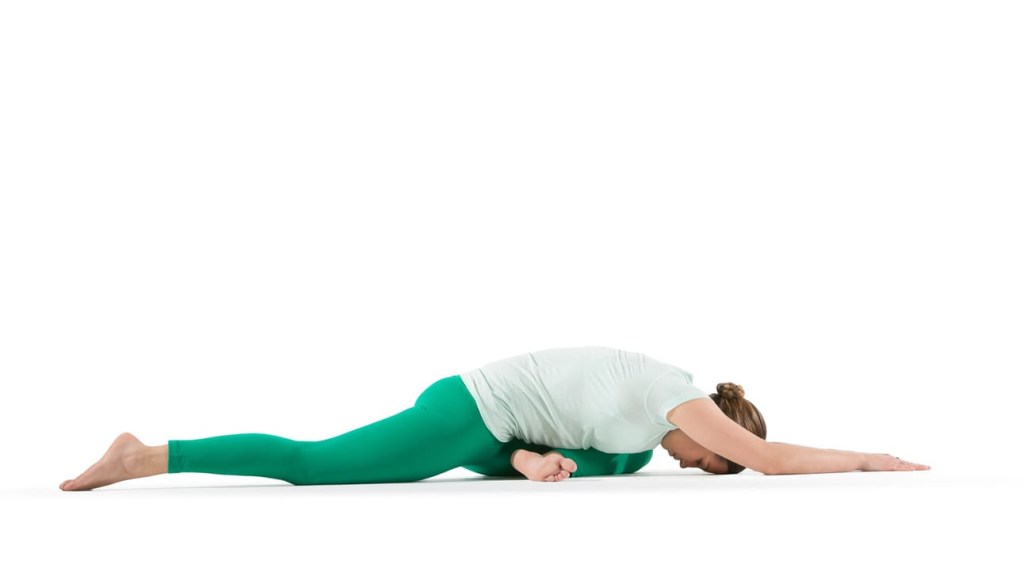
Downward-Facing Pigeon Pose (Adho mukha kapotasana)

What is Downward-Facing Pigeon Pose?
Downward-facing pigeon pose, or adho mukha kapotasana in Sanskrit, is a restful version of the upright pigeon pose. The torso folds over the front leg with the arms stretched forward in this deep hip opener.
Instructions
Begin in pigeon pose with the right leg extended back.Exhale and lower the torso down, walking the hands forward.Rest the forehead on the floor and press the palms together in prayer.Breathe while holding the pose.Inhale and release. Change sides.