The Power of Intentional Rest: Why active recovery matters as much as the hustle.

We live in a culture that glorifies the relentless hustle. From early-morning alarm flexes to “rise-and-grind” productivity hacks, we are constantly encouraged to do more, achieve faster, and keep moving. But in our quest to optimize output, we often ignore a foundational truth: sustained performance is impossible without intentional recovery.

Woman stretching on a yoga mat beside a sunlit window
A woman stretches on a yoga mat in the warm morning light beside a sunny window.

Rest is not a penalty, a sign of weakness, or something you earn only after burning out. When designed with intention, rest is a strategic accelerator—the precise mechanism that fuels creative breakthroughs, physical resilience, and sharp decision-making.

1. Passive Rest vs. Active Recovery

When most people think of rest, they envision passive recovery: collapsing on the couch, scrolling through social media, or sleeping in on weekends. While sleep and downtime are non-negotiable, passive rest alone doesn’t always recharge your system—especially if your mind is still racing with tasks, deadlines, and notifications.

Active recovery—a concept borrowed from athletic training—is about engaging in intentional, low-intensity activities that actively promote mental, physical, and emotional restoration.

Passive RestActive Recovery
Unconscious or disengaged downtimePurposeful, low-effort engagement
Scrolling social media, watching TVGentle movement, spending time in nature, creative play
Numbing fatigue temporarilyActively lowering cortisol and restoring balance

Active recovery helps flush stress out of your body, improves circulation, and gives your brain space to process ideas in the background.

2. Why Your Brain Needs “Unfocus” Time

Neuroscience shows that when you are deeply focused on a task, your brain relies on the Executive Control Network. But when you step away and allow your mind to wander during low-demand tasks—like taking a walk, taking a shower, or gardening—the brain activates its Default Mode Network (DMN).

The DMN is where the magic happens:

  • Problem Solving: It connects seemingly unrelated ideas, leading to “eureka” moments.
  • Memory Consolidation: It digests complex information gathered throughout the day.
  • Self-Reflection: It helps clarify your long-term values, priorities, and goals.

If you keep your brain constantly stimulated with work or screen time, you rob it of the chance to activate the DMN and consolidate learning.

3. The 4 Dimensions of Intentional Rest

To build an active recovery routine that actually works, consider incorporating rest across four key dimensions:

  1. Physical Rest: Moving gentle body parts through yoga, mobility stretches, light walks, or conscious breathwork.
  2. Mental Rest: Micro-breaks throughout the workday (e.g., the 50/10 rule: 50 minutes of focus, 10 minutes away from screens).
  3. Sensory Rest: Intentionally lowering environmental noise, turning off notifications, and stepping into quiet, natural light.
  4. Emotional Rest: Setting clear boundaries, saying “no” to non-essential commitments, and having spaces where you don’t have to perform or manage expectations.

4. How to Integrate Active Recovery Into Your Daily Routine

You don’t need a 3-day weekend or a retreat to start practicing active recovery. Start with micro-habits:

  • Schedule “White Space”: Treat rest with the same respect as a high-stakes business meeting. Block out 15–30 minutes daily marked simply as open time.
  • Disconnect movement from performance: Go for a 20-minute walk without tracking your pace, listening to a work podcast, or measuring metrics. Let it just be a walk.
  • Create a clear shut-down ritual: Signal to your brain that the “hustle” phase of the day is over—close your tabs, write down tomorrow’s top priorities, and step away from your workspace.

The Bottom Line

Hustle without rest isn’t dedication; it’s a slow burn toward exhaustion. High performers in athletics, business, and creative fields understand that recovery isn’t the opposite of work—it’s half of the equation.

By trading passive distraction for intentional, active rest, you give yourself the clarity, energy, and longevity to do your best work for years to come.


Navigating Big Transitions: Supporting loved ones (and yourself) through major life milestones.

Major life milestones—whether welcoming a new child, stepping into retirement, navigating a career pivot, relocating across the country, or coping with a significant loss—rarely feel like smooth, linear progressions. Even joyful transitions carry a quiet weight of adjustment, uncertainty, and grief for the chapter ending.

Two people sitting together on a sofa, one comforting the other
Two people share a quiet moment together in a warm, plant-filled living room.

Navigating these shifts requires balancing emotional presence for the people you care about with radical self-compassion for your own journey.

1. How to Support Loved Ones Through Major Milestones

When someone close to you is going through a massive life shift, standard well-wishing often falls short. Supporting them effectively means offering grounded, practical empathy rather than hollow platitudes.

  • Validate the mixed emotions: Major shifts are seldom 100% positive or 100% negative. A newly promoted friend might feel thrilled yet terrified; a retiree might feel relief alongside a loss of identity. Resist the urge to fix their anxiety with toxic positivity. Instead of saying, “Everything happens for a reason!” try, “It makes total sense that you’re feeling overwhelmed right now. I’m here with you.”
  • Shift from open-ended offers to specific actions: Asking “Let me know if you need anything” places the burden of logistics back on the person in transition. Replace generic offers with concrete, low-friction support:
    • “I’m dropping off dinner on Thursday around 6 PM—are there any dietary restrictions?”
    • “I have two hours open on Saturday morning. Can I come walk the dog or run errands for you?”
  • Protect their decision-making bandwidth: High-stress transitions trigger decision fatigue. Keep communications simple, direct, and free of unnecessary pressure. If you are offering help, frame it so they can give a simple yes or no.
  • Check in long after the main event: Support naturally floods in during the week of the wedding, birth, move, or funeral, but it tends to fade quickly. Set calendar reminders to check in weeks and months later, when the quiet reality of the transition fully sets in.
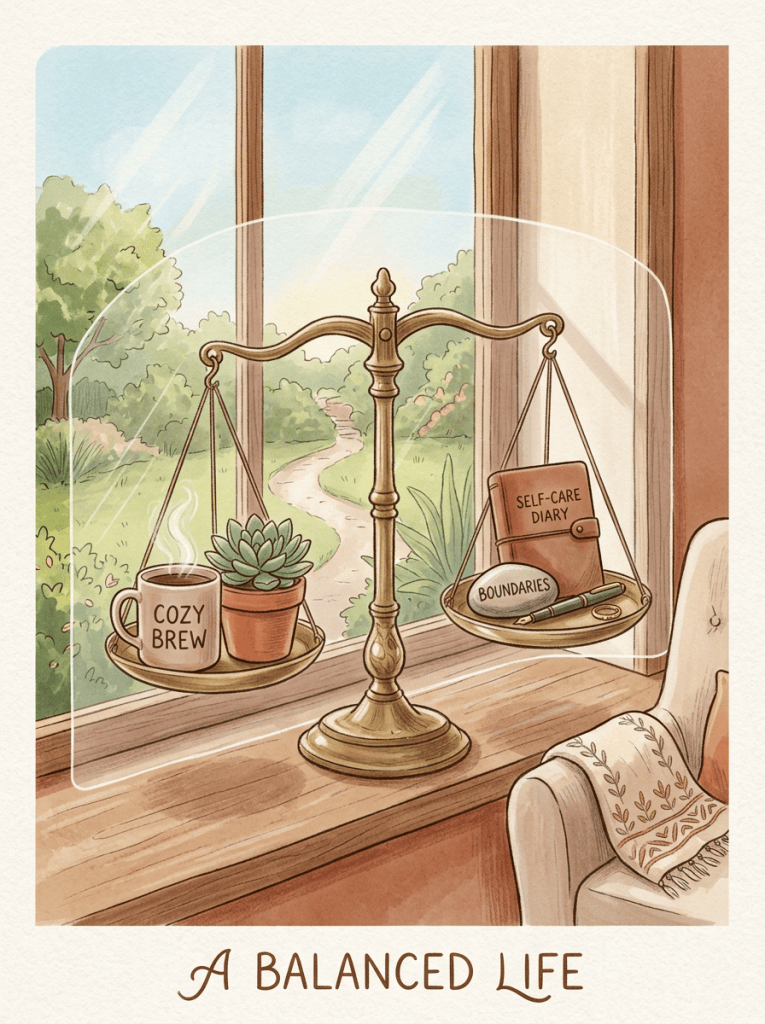
Balance scale with coffee, succulent, self-care diary, boundaries, and text “A BALANCED LIFE”
A cozy balance-themed vignette pairs coffee, reflection, and personal boundaries by a sunny window.

2. Supporting Yourself in Times of Change

It is impossible to offer stable support to others if your own foundation is buckling. When you are the one experiencing the shift—or carrying the emotional load of a loved one’s change—your primary job is self-anchoring.

  • Maintain non-negotiable micro-routines: When your entire world feels rearranged, tiny habits preserve a sense of agency. Keep two or three simple daily anchors unchanged: drinking your morning coffee in quiet, a 10-minute evening walk, or reading before bed.
  • Acknowledge the invisible grief: Every milestone involves leaving something behind. Acknowledging that a piece of your old lifestyle, identity, or routine is gone is not ungrateful; it is essential for processing change healthily.
  • Set firm relational boundaries: You do not have to be available to everyone at all times during a crisis or transition. It is completely acceptable to step back from non-essential social obligations or defer major secondary decisions until the immediate dust settles.
  • Practice lower-variance self-care: Swap grand self-care gestures (like elaborate vacations or spending sprees) for consistent, low-effort nourishment: proper sleep hygiene, basic hydration, and honest conversations with a trusted friend or therapist.
Watercolor landscape with winding paths, wildflowers, and distant figures
Winding paths converge across a softly painted meadow beneath a pastel sky.

3. The Power of Shared Grace

The hardest part of any life transition is the awkward in-between stage—the space where the old way of living has ended, but the new routine hasn’t fully formed.

Whether you are walking through the fire yourself or holding space for someone else, the ultimate tool is patience. Give yourself and your loved ones permission to be clumsy, tired, and imperfect while figuring out the new normal. Milestones mark a single moment in time, but adjusting to them is a quiet, continuous art.

Beyond the Costume: Deconstructing Samhain, Liminality, and the Pagan New Year

When October 31st arrives, modern culture paints the night in plastic skeletons, jump scares, and neon orange lights. Halloween has become a commercial holiday synonymous with horror, spookiness, and things that go bump in the night.

But if you strip away the plastic and trace the roots back two thousand years to the pastoral landscapes of ancient Ireland, Scotland, and the Isle of Man, you discover a profound, highly sophisticated spiritual threshold: Samhain (pronounced SOW-in).

Misty autumn woodland path surrounded by moss-covered standing stones
A misty forest path winds through ancient standing stones beneath vivid autumn trees.

For the ancient Celts, Samhain wasn’t a night of terror. It was the Pagan New Year, a sacred pause in the wheel of time, and a quiet masterclass in the power of liminality.

The Celtic Calendar: Darkness Precedes the Light

To understand Samhain, you have to understand how the Celts measured time.

Unlike our modern Gregorian calendar—which starts the day at midnight and the year in January—the Celtic day began at sunset. Every cycle started in darkness. The dark was not viewed as inherently evil or dead; it was the fertile womb of creation. Just as a seed must sit in the dark earth before sprouting, the year had to begin in the dark half.

Samhain translates directly to “Summer’s End.” It marked the final harvest, the butchering of livestock for winter survival, and the turning of the key into the dark months. Because it stood precisely between the autumn equinox and the winter solstice, it was considered a day that belonged to neither the old year nor the new year.

It existed out of time.

The Power of Liminality: Being “In-Between”

In anthropology and esotericism, the word liminal comes from the Latin limen, meaning “threshold.” A liminal state is a space of transition—the coastline between land and sea, dusk between day and night, or the doorway between two rooms.

Samhain was the ultimate liminal threshold of the year.

Because the day was neither fully past nor fully future, the Celts believed the energetic structure of reality softened. The invisible boundary—often called “the veil”—between the physical world (Midgard/Earth) and the spiritual realm (the Otherworld) thinned.

  [ THE PHYSICAL REALM ]  <====== The Thin Veil ======>  [ THE OTHERWORLD ]
     (Living / Earth)            (Liminal Space)          (Ancestors / Spirit)
Candlelit rustic table with apples, bread, bowl, and autumn leaves by an open door
A candlelit rustic table sets a warm autumn scene against a moonlit forest.

Why the Celts Didn’t Fear the Spirits

Modern Halloween movies tell us that when the veil thins, monsters come through to harm us. But the ancient Celts had a vastly different, more integrated relationship with death and spirit.

To the Celts, the dead were not monstrous; they were family.

  • Ancestral Wisdom: The dark months of winter brought cold, hardship, and isolation. The Celts welcomed the spirits of their ancestors back to the hearth on Samhain because those spirits possessed the wisdom of the ages. They came seeking warmth, but they left behind guidance, comfort, and protection for the living.
  • The Dumb Supper: Families would set extra places at the dinner table, leave the doors unlocked, and keep the hearth fires burning bright. Food was shared, and quiet respect was paid.
  • Guising & Protection: What about the scary masks? The Celts did acknowledge that not every spirit coming through a thin veil was friendly. To protect themselves from mischievous nature spirits (Aos Sí) or disoriented souls, they wore simple costumes of animal skins or blackened their faces with hearth ash (a practice called guising). It wasn’t to look spooky—it was energetic camouflage to blend into the night.

The Modern Takeaway: Finding Comfort in the Threshold

We live in a culture that demands constant light, high output, and endless summer productivity. We are taught to fear the dark, fear stillness, and fear aging or death.

Samhain invites us to deconstruct that fear.

Standing on the threshold of winter doesn’t mean everything is dying; it means nature is taking a breath. When you look at Samhain through the lens of liminality, the thinning of the veil becomes an invitation to:

  1. Honor those who came before you: Acknowledge the lineage, wisdom, and hardships of your ancestors.
  2. Embrace your own “in-between” spaces: If you are currently in a transition period in your life—between jobs, relationships, or mindsets—remember that liminal space is where real transformation happens.
  3. Rest without guilt: Welcome the dark half of the year as a period of necessary rest, reflection, and quiet inner alchemy.

The Light & Dark Audit: A Cozy Equinox Balance Inventory

Happy Autumn Equinox! 🍂

Astronomically, the Equinox is the exact moment when day and night are of equal length. Nature is standing on a knife’s edge between light and dark, outward action and quiet retreat.

Most autumn advice tells you to immediately switch into overdrive—buy all the candles, start ten new projects, or overhaul your entire life before winter hits. But the Equinox isn’t about rushing; it’s about recalibrating.

To help you reset your home, mind, and daily routine for the darker half of the year, we’ve created The Light & Dark Audit. Grab a warm drink, your favorite journal, and let’s take inventory.

Open stone cottage door with autumn leaves, harvest basket, and lantern
An open cottage door welcomes visitors with autumn leaves, harvest produce, and glowing lantern light.

Part 1: The Quick Equinox Home & Mind Reset

Check off the boxes that resonate with you right now. No scoring, no pressure—just notice where your energy is calling for a shift.

☀️ Sun Energy (Outward Clearing & Active Growth)

  • [ ] The Threshold Cleanse: Swept your front entry or porch to welcome fresh fall energy.
  • [ ] The Harvest Inventory: Celebrated 3 things you successfully grew, launched, or finished since spring.
  • [ ] Pared-Down Surroundings: Cleared physical clutter from your main workspace or kitchen counters to make room for cozy indoor living.
  • [ ] Seasonal Pantry Swap: Rotated your pantry to feature warm, grounding foods (root vegetables, spices, warm teas).

🌙 Moon Energy (Inward Comfort & Restful Integration)

  • [ ] Nesting the Sanctuary: Layered extra warm blankets, softer lighting, or cozy textures onto your bed or favorite reading nook.
  • [ ] The Evening Wind-Down: Established a digital curfew or quiet hour before sleep as the nights grow longer.
  • [ ] Honoring the Pause: Said “no” to an unnecessary obligation to protect your rest cycle.
  • [ ] Shadow Recognition: Identified one belief, habit, or old fear you are ready to let fall away like autumn leaves.
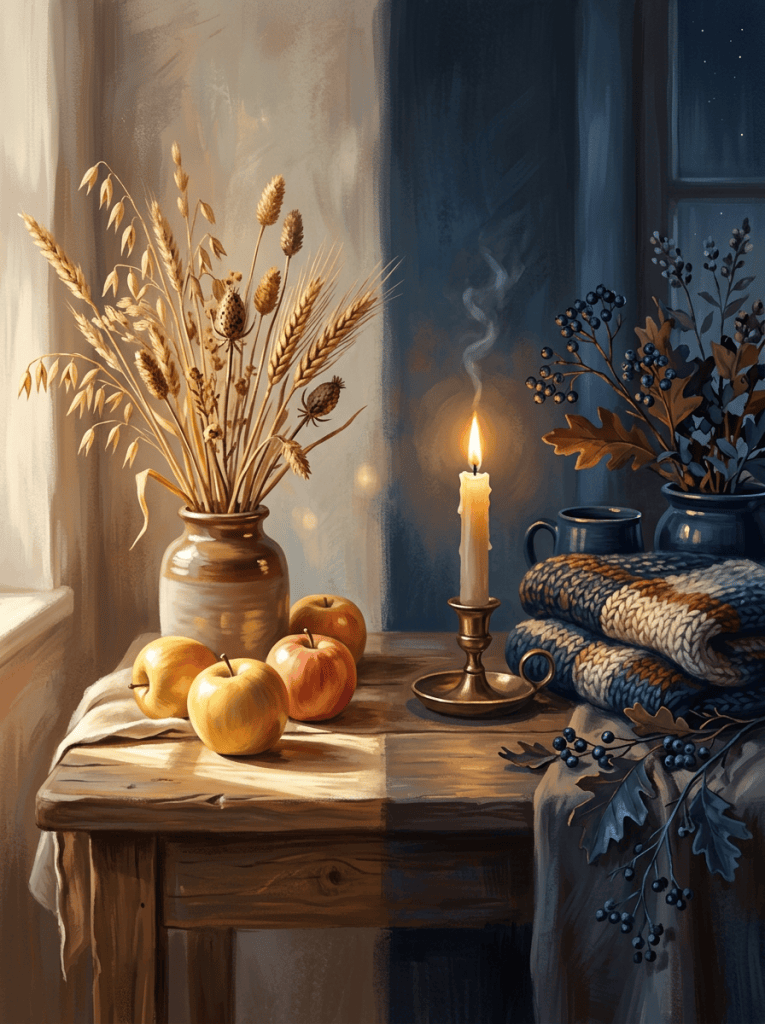
Candlelit autumn still life with apples, dried wheat, blankets, and berries
A candlelit autumn still life pairs golden apples and dried wheat with knitted blankets and dark berries.

Part 2: The Light & Dark Journaling Audit

In ancient traditions, the transition into autumn meant storing up fuel for the cold months. In modern life, your attention and energy are your fuel.

Draw two columns in your journal. Label the left side “Daylight / Outer Growth” and the right side “Nightfall / Inner Integration.” Work through the prompts below to see where your scales are tipping.

       LIGHT (Daylight)               DARK (Nightfall)
 -----------------------------  -----------------------------
  Outward Action & Creation     Rest, Reflection & Inner Work
  Building & Socializing        Boundaries & Shadow Integration
  What is expanding?            What needs to rest?

1. Daylight Audit (Active Energy)

  • What requires your active focus right now? (Projects, fitness routines, work goals, social connections).
  • Where are you over-extending? Are you spending daytime energy on things that don’t yield a “harvest”?
  • Equinox Action: Choose one main area of focus for the rest of autumn and let the rest sit on the back burner.

2. Nightfall Audit (Rest & Integration)

  • How are you preparing for longer nights? When the sun sets earlier, how does your body and mind react?
  • What parts of yourself need comfort? (e.g., more sleep, quiet reading time, shadow work, gentle movement like Yin Yoga or slow walks).
  • Equinox Action: Define one cozy evening ritual that signals to your nervous system that it is safe to rest.

Part 3: The Equinox Balance Pact

To seal your inventory, write a short, 1-sentence pact to yourself for the coming season. Fill in the blanks:

“As the days shorten, I honor my light by focusing on ______________, and I honor my dark by giving myself permission to _____________.”

Share Your Audit!

Did your audit lean more toward the Sun or the Moon? Share your Equinox pact or favorite cozy reset ritual in the comments below! 🕯️✨

The Alchemist’s Kitchen: Apple Magic & A Simmer Pot for Protection & Abundance

There is a distinct kind of alchemy that happens in the home during autumn. As the air outside turns crisp and the evening darkness creeps in earlier, our focus naturally shifts back to the hearth—the ancient heart of the home.

While modern autumn decor often leans heavily into standard pumpkin spice, witches, folk magic practitioners, and home herbalists have long turned to a different sacred symbol of the fall harvest: the humble apple.

Long before it was a staple in fall baking, the apple was revered as a powerful tool for divination, protection, and transformation. Today, we’re stepping into the kitchen alchemist’s domain to explore the hidden symbolism of the apple and craft a slow, aromatic simmer pot designed to fill your home with warmth, abundance, and clear energy.

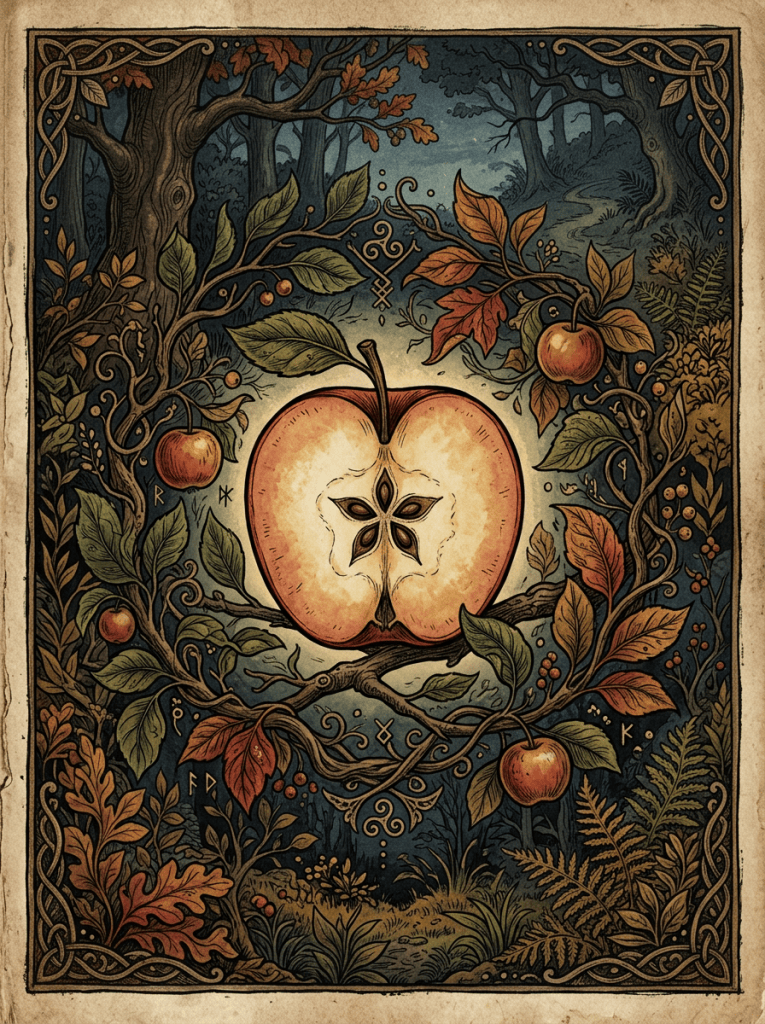
Sliced apple folklore illustration in dusky woodland

The Secret in the Core: Apple Folklore & Sacred Geometry

If you slice an apple horizontally through its center rather than vertically from stem to base, you’ll uncover one of nature’s most famous hidden secrets: a perfect, natural five-pointed star (pentagram) formed by the seed chambers.

In ancient Celtic and European traditions, this five-pointed star made the apple a symbol of divine protection, knowledge, and the five elements (Earth, Air, Fire, Water, and Spirit).

  • Avalon & The Otherworld: The legendary island of Avalon—a realm of healing, magic, and rebirth—translates literally to “The Island of Apples.” In myth, eating an apple from Avalon granted immortal wisdom and spiritual safe passage.
  • Apples as Wards: Hanging dried apple garlands across entryways or leaving fresh apples near doors was traditionally believed to ward off negative energy and welcome benevolent spirits.
  • Love & Divination: Old folk traditions used apple peels to predict future loves, tossing a continuous peel over the shoulder to see what initial it formed on the ground.

When you cook with apples in the fall, you aren’t just preparing food—you’re engaging with centuries of hearth magic.

Autumn simmer pot still life with apples and spices

Kitchen Alchemy: The Abundance & Protection Simmer Pot

A simmer pot (sometimes called stove-top potpourri) is one of the easiest, most accessible ways to practice kitchen magic. As the water heats, the plant materials release their essential oils, filling your living space with rich aromas while broadcasting your intentions into your home.

This blend pairs the protective pentagram energy of the apple with warm, uplifting spices to draw in comfort, prosperity, and peace.

Ingredients & Their Spiritual Properties:

  • 1–2 Fresh Apples (or saved peels and cores): For protection, health, love, and heart-centered magic. Be sure to slice at least one horizontally to reveal the five-pointed star.
  • 2–3 Cinnamon Sticks: Known for raising spiritual vibrations, accelerating intentions, and attracting abundance and warmth.
  • 1 tablespoon Whole Cloves: A classic protective botanical used to drive away stagnant energy, banish gossip, and secure the home space.
  • 3–4 Whole Star Anise: Enhances psychic intuition, brings good fortune, and mirrors the star energy of the apple core.
  • 1 small Orange (sliced) or Dried Citrus: To bring the radiant energy of the sun into the darkening season, promoting joy and vitality.
  • Fresh Rosemary sprigs (Optional): For clarity, memory, and clearing away heavy atmosphere.
  • Filtered Water

Step-by-Step Simmer Pot Ritual

  1. Prepare Your Space: Clear off your stove or set up a small slow cooker. Take a slow, grounding breath as you gather your botanicals.
  2. Slice with Intention: As you slice your apple horizontally, pause to admire the five-pointed star in the center. Mentally set an intention for your home—such as peace, warmth, protection, or financial ease.
  3. Assemble the Pot: Place your ingredients into a medium pot or slow cooker. Cover them with water, leaving an inch or two at the top.
  4. Stir & Simmer: Bring the water to a gentle boil, then immediately lower the heat to a low simmer. As you stir the pot clockwise (the traditional direction for inviting positive energy), visualize the steam lifting away tension and filling your room with golden, protective light.
  5. Maintain the Brew: Keep an eye on your pot throughout the day, topping it off with warm water every couple of hours so the ingredients don’t burn.

Safety Note: Never leave a stove simmer pot unattended. If you need to leave the house or go to sleep, turn off the burner or use a low-heat slow cooker on a heat-safe counter.

Composting the Magic

When your simmer pot has given all its fragrance (usually after a day or two of gentle re-heating), do not simply toss the botanicals into the trash. Express gratitude to the plants for their energy and aroma, and return them to the earth by adding them to your garden compost or burying them beneath a yard tree.

By honoring the rhythm of the season in small, intentional ways, we turn everyday household tasks into moments of quiet magic and profound comfort.